Mia Kivinen: Pretty Ordinary Art
Light Art And Its Alleged Lack Of Criticism
“There’s no criticism of light art” is a phrase I often hear. It may be true. What should this criticism be like, and what should its writer know? And why should one even write reviews of light art?
“Almost the “purest” material in art”
What exactly is light art? For some, it means a spectacular light show; for others, it means a beautiful reflection of light from a window or cosy candlelight. I have been pushing the definition I developed for my thesis with some success: Light art is visual art in which light plays a defining role, either as a material or a theme. Light is not present just for the sake of visibility, and its quality matters.
Sounds simple, but it isn’t. The world-embracing claim that all art is light art, because without light the work would not even be seen, is not valid. Lighting conditions affect artworks, but visibility is only one function of light. If light is not significant for the content of the work, the work is not light art.
Light art is not a separate genre from other visual arts, but can take almost any form. Most light artworks may be classified as sculptures or installations, but a light artwork can also be a performance, a land artwork, a painting, an intervention, or a textile artwork. For example, the creations by Maija Lavonen (1931–2023) that feature optical fibers, exhibited in 2025 at the Architecture and Design Museum in Helsinki, easily fall into the category of light art.
In some definitions, light art is limited to electric light, with no argument whatsoever. Sun, fire, or other natural light can be material for light art, and even darkness is not always necessary. The gallery for Anu Raatikainen’s “Phototaxis” exhibition (2024) was Pitkäkoski Meadow1Pitkäkoski Meadow (Pitkäkoskenniitty) is located in Helsinki’s Central Park. It is an open, riverside flood meadow slated for designation as a nature reserve in 2024. In August-September 2024, it hosted “Phototaxis,” an art exhibition featuring augmented-reality (AR) works and sun-follower sculptures that blend nature with technology., bathing in sunlight, and some of the works were based on the sun’s reflections.
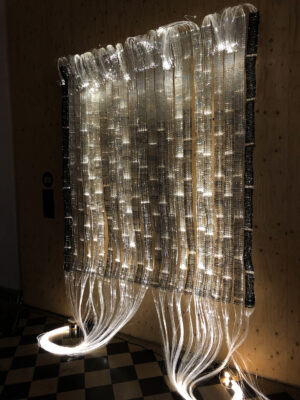
Light art is not just about large festival works; it can be tiny, subtle, and even conceptual. Jenni Eskola’s chlorophyll paintings, which change with light over time, were included in a light art exhibition (2020 and 2021) because of light’s defining role in the work. So light art does not necessarily even need its own light to shine.
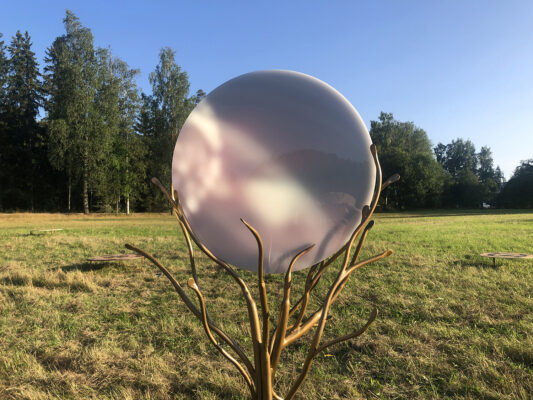
“There’s a likelihood of light art and go-go dancers to be seen in the space.”
Light art has many related genres that are often confused with one another. Drawing the line is not exactly simple. The most evident difference between light art and lighting design is that lighting design occurs during a performance and serves the performance. The easiest way to distinguish lighting design from light art is to check whether there are performers in the space, perhaps even on a stage. No matter how excellent or unique the lighting design is, this does not make it light art. It is not a question of quality or prestige, but of classification. Borderline cases here include, for example, light-based performance art and performances that take place in an existing light artwork. The artwork “Artgeologists” (2019) by the Artist Collective Kunst 2 “Artist Collective Kunst” is a collaborative unit of Finnish artists Christina Holmlund, Pia Paldanius, Sirpa Päivinen, Anu Suhonen, and Julia Weckman. The collective works with contemporary environmental and social issues and offers alternative ways of seeing., with its eerily glowing performers, falls interestingly between performance and installation.
The difference between lighting and light art is also related to the instrumental value: the task of lighting is to present the illuminated object in a certain, pre-defined way, usually pretty, which is not the task of art. It is especially difficult to draw the line in architectural lighting: sometimes the lighting creates a completely different impression when it gets dark than how the building looks during the day. The facade work of the Folks Hotel in Helsinki (2020) by Sun Effects serves both as lighting and as an artwork in its own right. It uses light to draw an entity that repeats the shapes of the building in its own unique way, and it would also work sans the house.
It is even more challenging to draw a line between light art and video art, and the distinction is not made easier by the fact that video art is also a regular guest at light art events. Both belong to the media arts and share some equipment; the light from a video projector can be a figurative image or an abstract light shape, and a monitor can be an image source or a shining light cube. As a rough guideline, in video art, the content of the image is more important, and in light art, the light itself plays the leading role.
Terike Haapoja has puzzled classifiers with several of her artworks, the most famous of which is probably “Entropy” (2004), which has also been shown at light art events. In it, a horse carcass cooling down after death is filmed with a thermal camera, and the image becomes increasingly unrecognizable and abstract as the horse cools.
Sometimes decorative lights and festive lighting are also called light art, but I assume that’s just frivolous foolery, stiffen my upper lip, and walk on by.

“A huge final spurt to the light art event”
The traditional division in light art has been between festival and gallery art. In this division, festival art is big and spectacular, while gallery art is intimate and profound. This division, which has never been entirely clear, has become even more blurred as artists have begun working in both fields. Festivals also come in different sizes and styles; I’ve curated both the largest and the smallest light art festivals in Finland. “Thesmallest Vallila” (2025) was less than 1% of the size, budget, and audience of Lux Helsinki, and was also more minimalist in style.
Cities and municipalities organize a large share of light art festivals, and their primary goal is to provide pleasant experiences for as large a share of the taxpayer population as possible and to appeal to tourists as well. And light does appeal. The most visible difference between light art and other visual arts is its popularity with the audience. It is also its biggest curse. Few galleries have to consider their exhibition selections based on the logistics of hundreds of thousands of people. Also, a few galleries choose their artworks with the goal of the whole city liking them.
From this point of view, it is risky to choose the most experimental cutting edge of light art for events aimed at the general public, and the focus is usually on visual splendour. Especially at the most crowded events, the works must be large and quick to experience, with the crowd pushing the viewer towards the next artwork. This does not exclude profound content, but it does limit the choice of artworks.
“Beyond Intellectualization”
The alleged entertainment-heaviness of light art is a sore point among light art professionals, especially at festivals. Curators discuss the lack of content among themselves, but the artworks that end up at festivals are often those that rely on visual impact or technical ingenuity.

With some of the artworks, we could talk openly about entertainment. Entertainment has its own substantial value that is easy to justify, especially in these endlessly bleak and apocalyptic times. Why not just give people a moment of delight instead of requiring them to dwell in the deepest of thoughts?
“A trend approaching a photo-theoretical observation tool”
The light art industry has taken shape here. As if by a common decision, the custom of naming events as light events or light art events, depending on their artistic goals, has spread. Criticism should be in line with this. Just as a theater critic approaches a farce and a contemporary theater piece with different expectations, so should they with light entertainment and light art. There’s nothing wrong with a spectacle, as long as it is done properly.
Traditionally, light art artists have been some gyro gearloosers of the art world and its fringes, who have done what they like and supported each other in technical and artistic issues. There has been a close connection to kinetic art; for example, long-time light artist Annikki Luukela (b.1944) has been working in the Dimensio group, known especially for kinetic art, and was its founding member. The kinetic works of Eino Ruutsalo (1921–2001) were also light artworks.
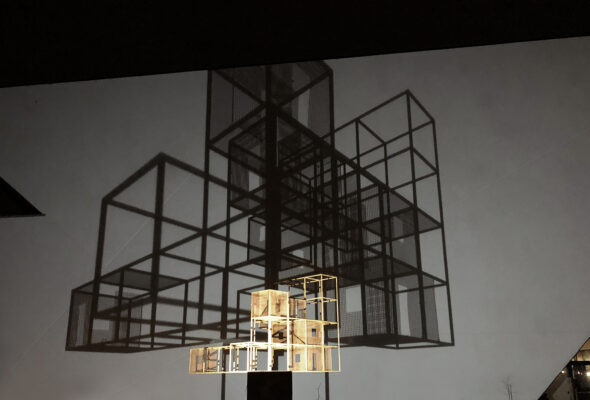
As lighting design education has developed, it has become a foundation for many artists. Lighting design background unites, among others, Kaisa Salmi (b.1968), Terike Haapoja (b. 1974), Alexander Salvesen (b.1990), and Jani-Matti Salo (b.1984). Light unites many art genres, and the group of artists who use light is also diverse: in addition to the above-mentioned, it includes architects, graphic designers, set designers, video visualizers, engineers, photographers, and musicians. To begin with. The groups have remained quite separate, but in recent years – primarily due to the influence of the Light Art Society – they have started to find each other. This can only benefit everyone.
Not all artists who use light call themselves “light artists”. Often, this is because artists work with other materials as well, but the stigma of light art also plays a part. One artist vehemently denied that he was doing light art, even though I caught him red-handed designing a work that had only light as material. Naturally, I don’t understand this light art shaming, but the artists decide for themselves what their title is or how they name their art.
“Light art can sometimes be amazingly direct and efficient.”
Why aren’t there any reviews written about light art? This is a kind of trick question, since reviews are indeed written about light art, it’s just not called light art in them. And when it is, the text is usually a blurb or a news item, not a review. There is a considerable number of undercover light artists in Finland. Usually, for example, Jaakko Niemelä (b. 1959), Maaria Wirkkala (b.1954), Vappu Rossi (b.1976), or the Grönlund-Nisunen artist duo are not marketed as the leading light artists, even though they often use light in their works. And they use it brilliantly, I might add.
The expression “light art” is not mentioned in the review, so it cannot be found by searching for it online. When these reviews are taken into account, light art does not necessarily suffer from underrepresentation any more than other art forms – especially when you consider the ever-decreasing number of reviews in general.
Festivals and larger artworks, especially those displayed in public spaces, often end up in city news rather than the culture section. Because of this emphasis, the writer rushes to say, perhaps offhand, a few words about art to get to the real point: the number of visitors, lamps, and electricity consumption, and, in the winter, also the cold weather and the bringing of light into the darkness. A lot of these fluff-like texts are written about light art. I believe and hope that Maaria Wirkkala is not asked how many lamps there are in her exhibitions.
“In addition to food for the eyes, fuel for thoughts”
In recent years, light art, which is openly called light art, has also found its way into the halls of museums and galleries, in group exhibitions dedicated to it. “Lux & Umbra” at WAM Turku City Art Museum in 2024 and “Boisterous Light” at Museum Center Taika in 2023 brought together works by artists from different backgrounds, specifically in the context of light. The FLASH biennials of the Finnish Light Art Society FLASH have presented Finnish contemporary light art in three editions since 2017, and the fourth edition, “New Darkness” (2024), expanded the coverage to older works, too. The “Material Light” exhibitions of FLASH, MUUry, and the Northern Photography Center (2020 and 2021) focused on light as an element. In addition, individual artists have held exhibitions focused on light art.
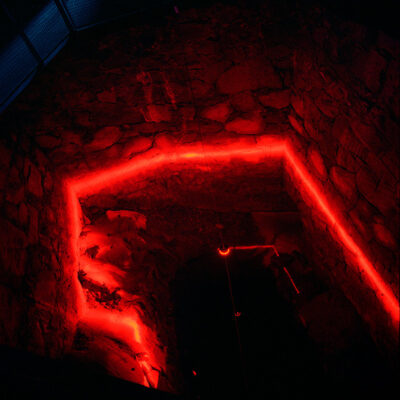
It would not be easy to write about these exhibitions without specifically considering light as an art medium, and an audience report cannot account for them. They have indeed led to a slow but steady movement of articles about light art towards the culture sections of magazines. Even the prestigious Finnish art magazine Taide has published Pessi Rautio’s review of the light art exhibitions of the 2023–2024 season.
Rautio has also paid commendable attention to light art over the years, and he is not the only one. Several names come to mind: Rosa Kuosmanen elegantly relates light art to other art genres and art history in her reviews. Kulttuuritoimitus magazine has reported on light events interestingly, especially with the pen of Päivi Vasara and Eli Harju, and Sanna Lipponen has approached light art from the perspective of a member of the audience.
“In the end, only light”
Light art needs criticism. Both inciting and challenging. Perhaps even more of the latter. What should a critic know about light art, then? Basically, no more or less than about other art forms. However, there are a few light-specific wishes. When writing about light art, the focus often turns to technique, which is not always essential to the work’s content. It is good for the critic to be familiar with the scope and diversity of the field of light art. Any comment about “light art in general” is usually as moot as “painting in general”.
When writing about light art, the focus is often on the technology, which is not always essential to the work’s content. Exhibition texts also repeatedly concentrate on the new and wonderful equipment and the scale of the work. One of the tasks of criticism is to challenge this emphasis and ask what the artwork actually wants to say. Light art is not a separate, special art form, although it is sometimes treated as such – for better or worse. Light is a common art material, and light art is art among other art forms. It deserves the same rigorous and understanding gaze.
Do not let us off easy.
PUBLISHED
Published 29 DEC 2025.
The text was originally published (in Finnish) in Kritiikin Uutiset Magazine on 11 DEC 2025.
MORE INFORMATION
The Finnish Light Art Society FLASH and SARV have jointly and separately held various training courses on light art and its criticism. It is worth following both sources of information!
SOURCES
The essay uses as sources discussions with curator colleagues, artists who use light, and critic Tuuli Penttinen-Lampisuo, reviews of light and other art published in Finland, as well as other articles, artworks, and events seen, own experiences, and Kivinen’s thesis for the Academy of Fine Arts, and the FLASH and SARV Light Art Criticism seminar on 23 November 2024. The subheaders are taken from light art reviews and other light culture-related articles.
AUTHOR
Mia Kivinen is a Helsinki-based curator, teacher, and advocate of light art.
DIVERSITY
15 artistic positions mentioned: 9 female, 4 male, 2 collectives
FOOTNOTES
- 1Pitkäkoski Meadow (Pitkäkoskenniitty) is located in Helsinki’s Central Park. It is an open, riverside flood meadow slated for designation as a nature reserve in 2024. In August-September 2024, it hosted “Phototaxis,” an art exhibition featuring augmented-reality (AR) works and sun-follower sculptures that blend nature with technology. ↩︎
- 2“Artist Collective Kunst” is a collaborative unit of Finnish artists Christina Holmlund, Pia Paldanius, Sirpa Päivinen, Anu Suhonen, and Julia Weckman. The collective works with contemporary environmental and social issues and offers alternative ways of seeing. ↩︎
