Bettina Pelz: Creating Commons
About SEE DJERBA, the international Media Art Festival in Houmt Souk/Djerba.
South West Asia and North Africa (SWANA) encompasses a diverse region where media art is increasingly used to explore digital culture, current challenges, and cultural heritage. Some festivals from CAIRORONICA in Cairo to FAK’UGESI in Johannesburg represent a mix of contemporary arts, photography and visual storytelling, immersive installations, and experimental work at the intersection of art, society, and technology. The SEE DJERBA Media Art Festival in the South of Tunisia is one of them.
Since 2017, SEE DJERBA has developed as a public art project, with editions in 2017, 2019, 2023, 2024, and 2025. In the beginning, it was planned as a biennial project, alternating with the INTERFERENCE Light Art Projects in Tunis. After the COVID-19 pandemic, SEE DJERBA has developed its own dynamic and now operates on an annual rhythm. It is a still new platform featuring digital media as artistic material and medium, creating space for contemporary art where there is none.
It developed as an open space to explore how artistic research, scientific inquiry, technology, and education can be combined to address local and global challenges. It scrutinizes media and communication literacy, data visualization, mixed realities, and artificial intelligence as tools for shaping a sustainable, democratic, and inclusive future. It fosters participatory, accessible, and sustainable engagement with Djerba’s complex heritage through the lens of contemporary media art, making culture a living, evolving practice rather than a fixed legacy. It harnesses art’s capacity to question, re-frame, and democratize cultural memory by inviting local communities and artists from local, national, and international contexts to collaborate in research and creation.
DIRECTED-BY
The project is directed by curators Aymen Gharbi and me, Bettina Pelz. We founded the project and developed it along with local communities and capacities. We profited from our backgrounds in architecture and heritage, in philosophy and socio-cultural work. We started to collaborate in 2015 and successfully managed the 1st edition of INTERFERENCE in Tunis in 2016. The idea to start an art project in Djerba developed during the making of INTERFERENCE. By chance, there was a larger number of Djerbians in the volunteers’ collective. Some months later, we met in Djerba to discuss the options.
Central to our approach is the balance among our interests, empathy, collectiveness, and leadership. We aim to resonate with local situations and atmospheres and to ambitiously synchronize diverse perspectives into a platform that is both meaningful and attuned to its context. Over the years, we have established a community-based setting to produce, experience, and discuss contemporary art. The community of making is built as a learning environment with lectures, workshops, training, and experimentation. To date, SEE DJERBA is a form of place-making through contemporary media art to accompany reflection, critique, and dialogue, enabling both artists and audiences to explore complex social, cultural, and environmental realities in discursive and thought-provoking ways.
CURATED-BY
For this year’s edition, we were supported by a team of young professionals – Fairouz Nouri, Johanna Baumgart, and Khadouja Tamzini – who co-developed the program and headed the curatorial studios for the on-site implementation. They selected local talents to assist with all curatorial tasks, engaged producers for technical production, and trained art mediators to care for the audience. They supported the team responsible for communication and documentation. It takes around one year to write applications, network with organisations, and discuss with partners to puzzle with ideas and opportunities, before we all meet on-site to share some weeks being in Djerba.
POSITIONS
The 2025 edition was a decentralized exhibition spanning 25 installations and two performative spaces, conceived to activate multiple cultural sites across the island’s center, Houmt Souk. Rooted in a place-based curatorial approach, the project unfolded across three distinct zones: the Old City Center, curated by Fairouz Nouri; the Maltese Quarter, curated by Khadouja Tamzini; and the Museum, curated by Johanna Baumgart. Together, these curated sections formed an interconnected artistic ecosystem that engaged contemporary practices while responding to the historical, social, and architectural specificity of each site.
DIGITAL MEDIA
While Djerba’s UNESCO Cultural Heritage sites offer insight into the island’s past, the SEE DJERBA Media Art Project focuses on researching and understanding the present, using digital media as the defining medium of the 21st century. Rapidly evolving technologies, changing software, and pervasive digital tools — from phones and screens to communication networks and surveillance systems — continually reshape social and cultural life, influencing communication, literacy, and sovereignty. SEE DJERBA emphasizes not only what technology can do but also what it should do for people, highlighting human needs, values, and agency amid digital transformation.
In media art, artists experiment with these new technologies, often along their limits, and also reflect on the impact of digital technologies, AI, and immersive experiences on human identity, social structures, and cultural shifts. Through critical reflection and creative engagement, the project positions media art as a space for experimentation, interdisciplinary dialogue, and imaginative futures, situating artistic practice at the center of social, cultural, and ethical discourse.
Examples of this year’s SEE DJERBA edition include the intervention by Ella Barclay, working with fiber optics and holographic displays at one of the museum’s historic sites, and the animation by Amira Chihaoui, who developed a visual current that drifted between natural patterns and technological distortion.
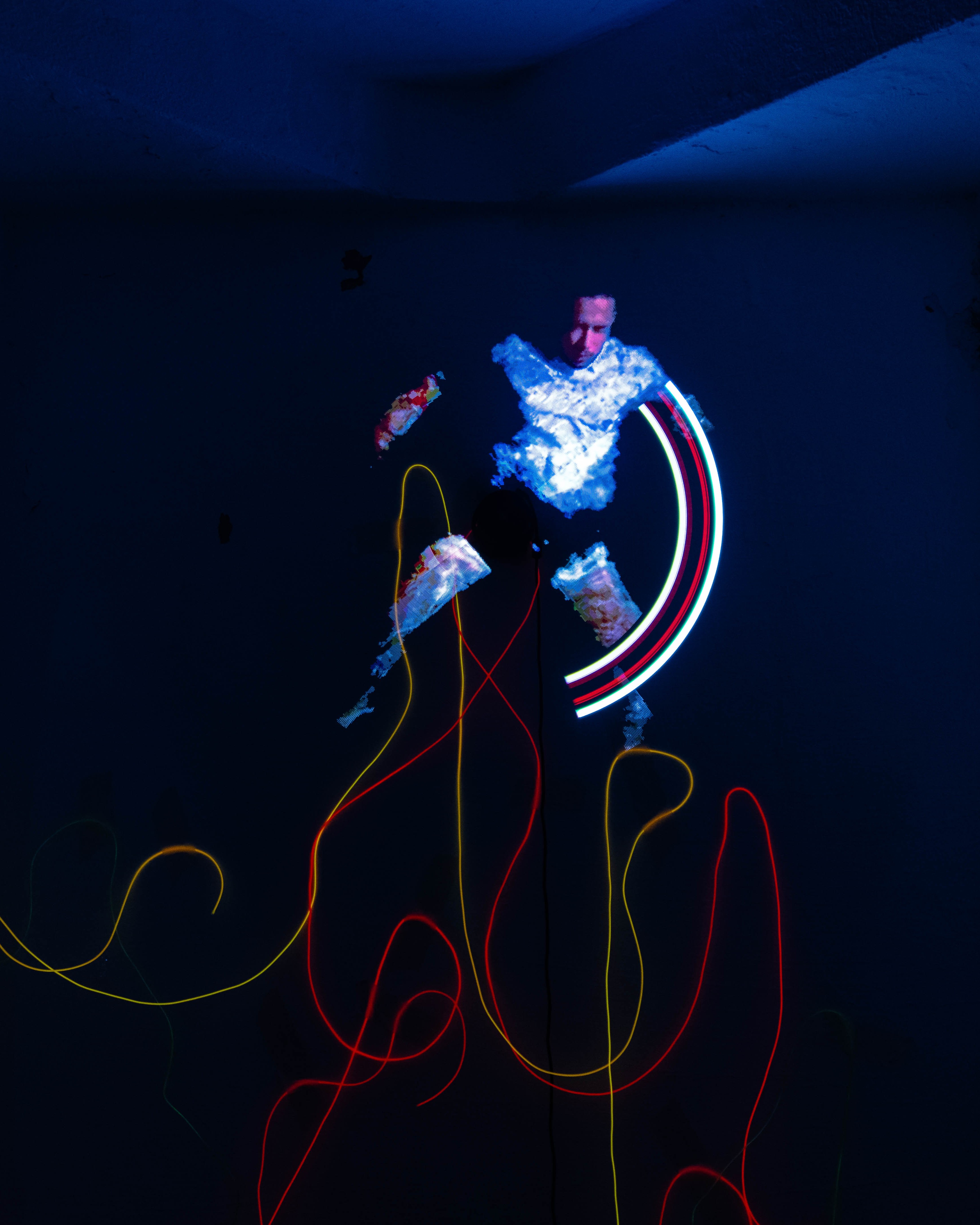


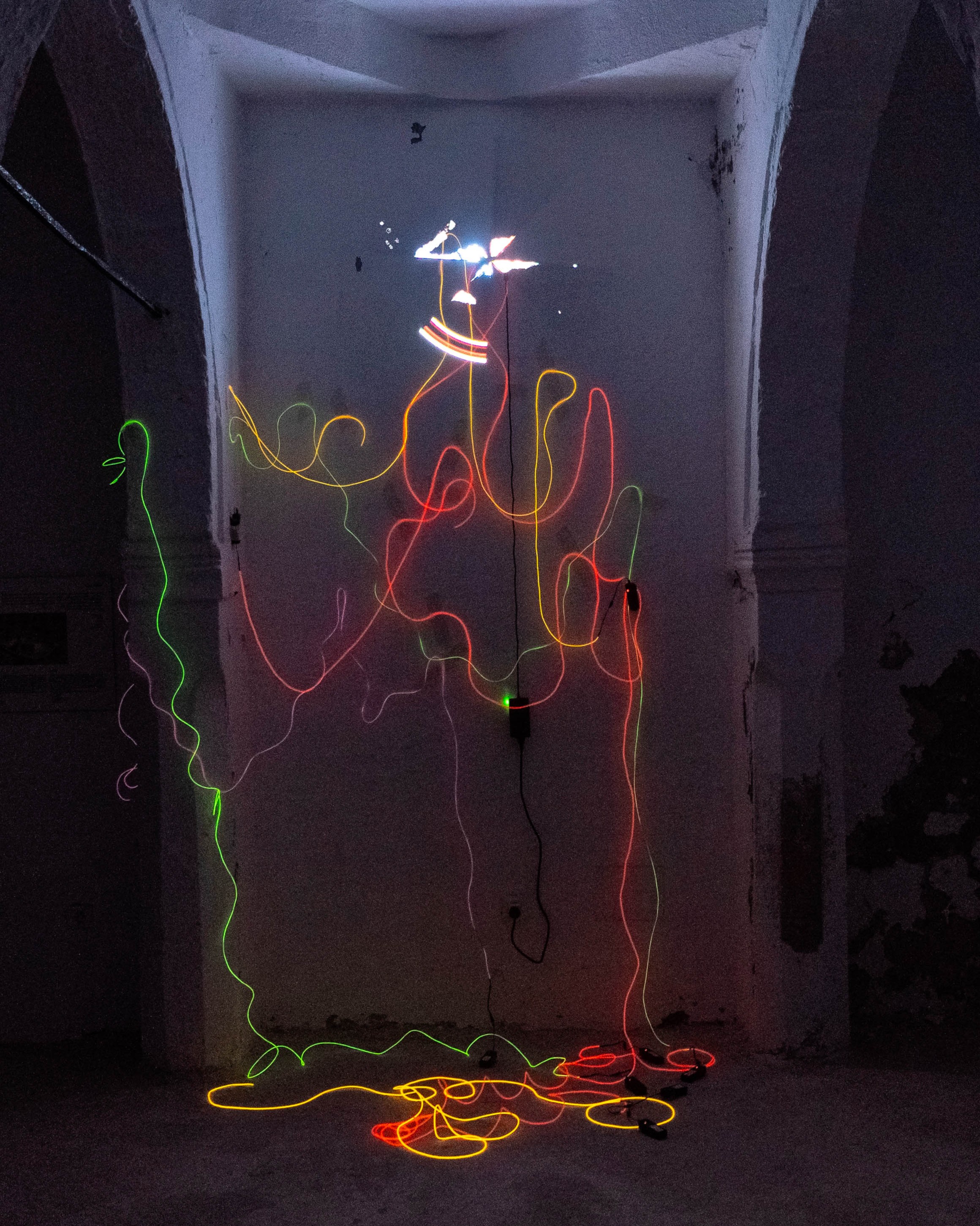

Ella Barclay: Compatible Formats
Museum
Ella Barclay’s “Compatible Formats” is a site-specific intervention that combined LED-powered fans and luminous, neon-colored fibers to transform the mausoleum space in the museum. Quietly whirring fans displayed holograms of bodies drifting weightlessly in water, while the fibers, resembling ethereal roots, extended into the room, asserting a presence that interacts with the architecture. The artwork highlighted the tension between past and future, as the experimental technologies activated the historical setting. By emphasizing the materiality and behavior of the holograms and fibers, the artwork demonstrates how advanced technology can extend, challenge and reframe historical spaces simultaneously.


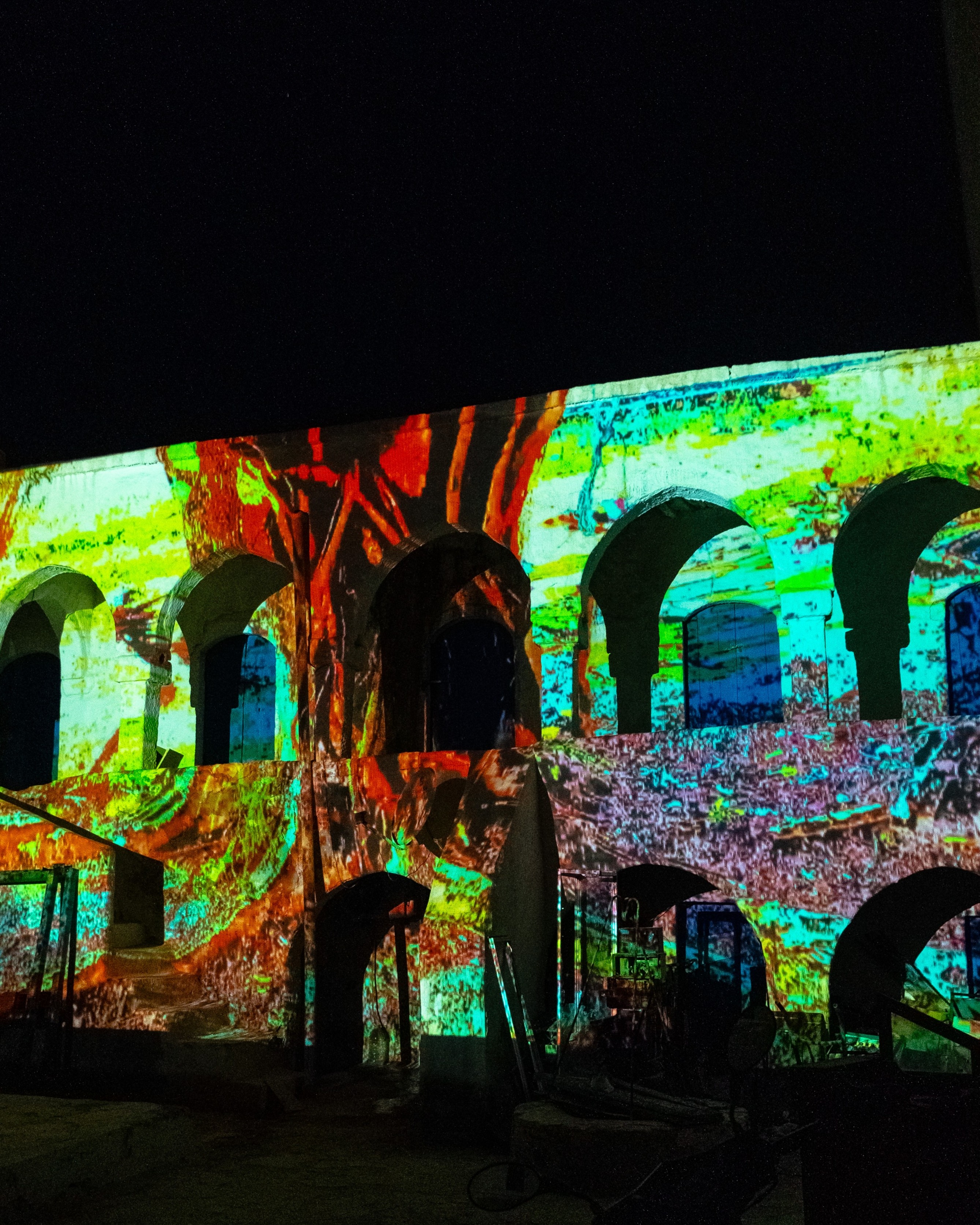


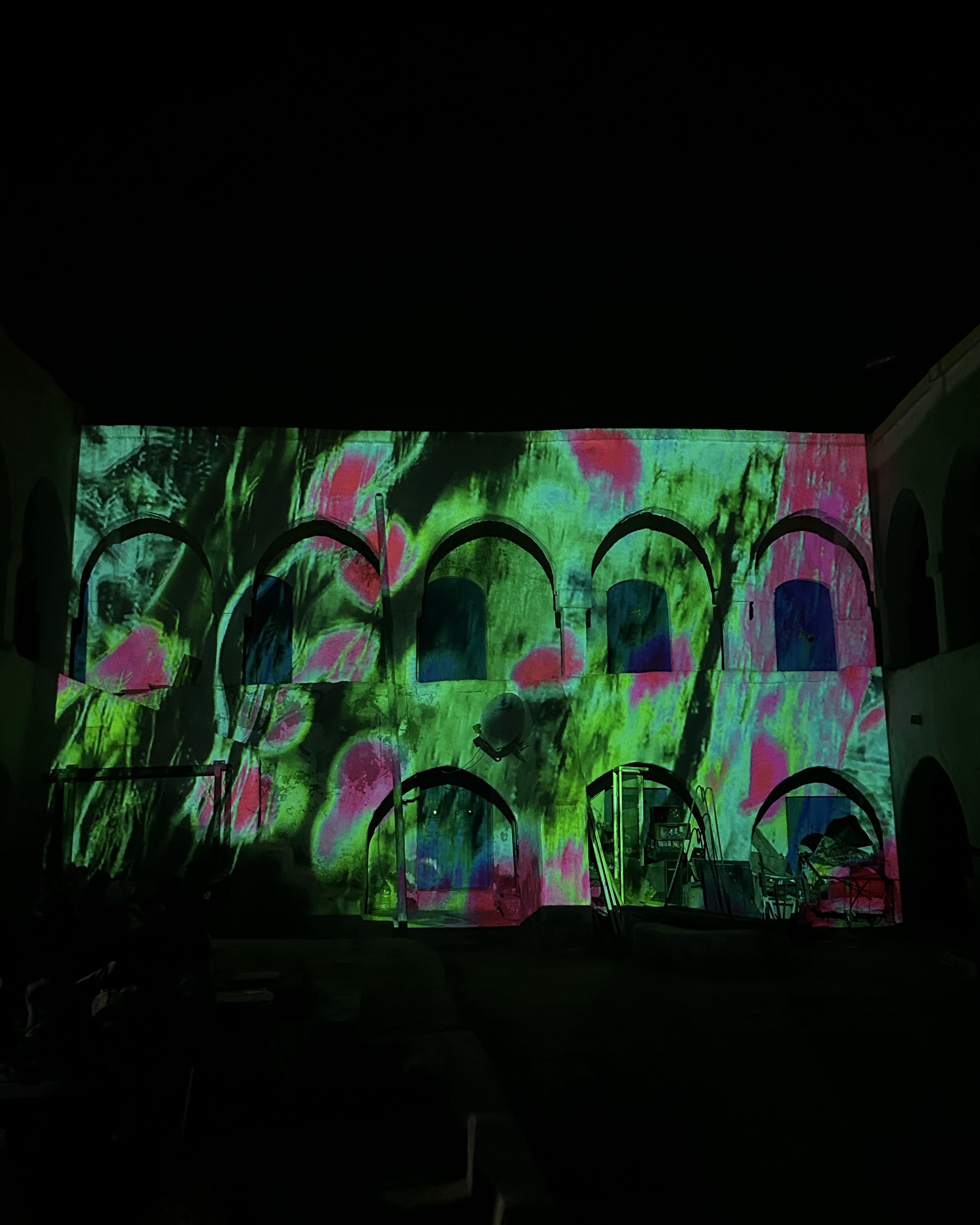


Amira Chihaoui: Roots – It Begins With Water
Fondouk Ben Ghorbel
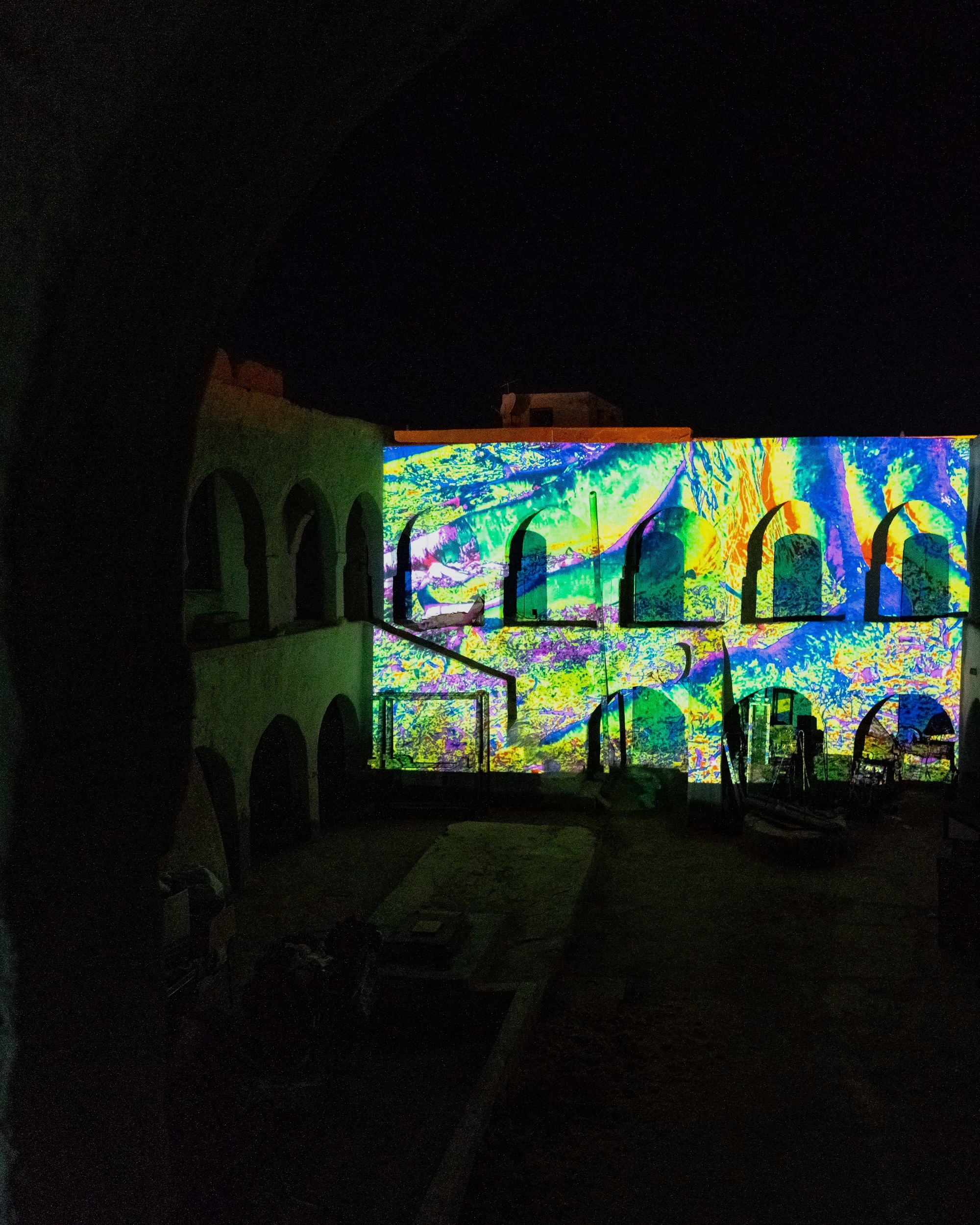
Amira Chihaoui traced the flow of water through rivers, seas, and plant systems as a metaphor for liveliness, connectivity, and transformation. Her imagery of gently moving water, spreading mycelium, and growing roots gradually dissolved. Through the technique of stretch, glitch, and data moshing, these visuals bent, and dissolved into color, texture, and frequencies. Exploring technological error and its aesthetics, Amira showed how nature’s flow and digital disruption can converge into a visual poetry.
Projected onto the central façade of the Fondouk Ben Ghorbel, the piece transforms architecture into a site of reflection on continuity, connectivity, and transformation, illustrating how natural forces and digital aesthetics can converge to reveal new ways of perceiving life’s dynamic flows.
SITES
The choice of sites is central to the conceptual framework, with each location selected to resonate with the artworks presented. Rather than serving as neutral backdrops, the sites actively inform the artistic propositions, encouraging a close alignment between spatial context and creative intent.
Artists are invited to adapt their works to the physical, historical, and social conditions of each setting, resulting in site-specific installations that emerge from dialogue with their surroundings. This emphasis on adaptation and contextual responsiveness reinforces the project’s commitment to meaningful encounters between art, place, and audience. It underscores the site’s role as a co-producer of meaning within the exhibition.
From the outset, fostering a dialogue among cultural heritage, living culture, and local value systems through contemporary art has been fundamental to SEE DJERBA 2025. This principle has guided not only the choice of sites but also the project’s approach to audience engagement.
By embedding contemporary artistic practices within well-known and culturally significant locations, the exhibition invited audiences to encounter familiar sites in new ways, encouraging renewed perception and critical reflection. Contemporary art became a mediating force, revealing overlooked aspects, accentuating everyday cultural practices, and repositioning heritage sites as dynamic spaces shaped by both memory and present-day experience.
In Houmt Souk, the absence of white-cube gallery spaces necessitates the presentation of contemporary art in public spaces and heritage environments, which gives rise to specific conditions and ongoing negotiations, including careful consideration of architectural qualities, lighting conditions, social contexts, and spiritual implications.
Within this approach, cultural heritage is not understood as a static body of knowledge to be preserved and transmitted unchanged, but as a dynamic context that can be questioned, reinterpreted, and reactivated through contemporary artistic practice. Artists and curators learn through direct engagement with heritage by relating historical material to present-day social, political, and cultural concerns; by collecting maps, data, and information; and by uncovering marginalized perspectives.
The notion of “dialogue” implies a reciprocal exchange: contemporary art draws on heritage for material, meaning, and context, while heritage itself is reshaped and reinterpreted through artistic intervention. This process fosters experiential, critical, and embodied forms of learning, in which knowledge emerges through making, viewing, participation, and reflection rather than through purely didactic modes. As a learning environment, this model supports interdisciplinary thinking, encourages critical awareness of history and memory, and enables participants to understand how cultural legacies are constructed, contested, and transformed over time.
Examples are Liudmila Siewerski’s “Where the Tide Remembers,” which transformed historic ASSIDJE images into drifting, pulsing pixels that mimic tidal movements. With dissolving figural outlines and abstract soundscapes, the work evokes the fluid, ever-changing nature of memory and cultural heritage. FYMA’s “SAKAN Corporeal Space” was a 2-channel video essay that explored the abandoned Skanès pavilions as a performative space. The work highlights the body as a medium for sensing and interpreting memory, revealing how decaying spaces can embody both history and lived experience.





Liudmila Siewerski: Where the Tide Remembers
Sidi Abdulkader Square
ASSIDJE stands for “Association pour la Sauvegarde et l’Intégration Sociale et le Développement de l’Île de Djerba” (en: Association for the Preservation and Social Integration and Development of the Island of Djerba), a Tunisian non-profit organization established in 1976 that works to support the harmonious development of Djerba. Its mission encompasses the preservation of the island’s ecological, urbanistic, architectural, and socio-economic heritage, while promoting cultural and community engagement across the island. The ASSIDJE organization has supported SEE DJERBA from the beginning, through all editions, in different ways. This year, they shared part of the photographic archive with artists, allowing them to choose freely what to work with.
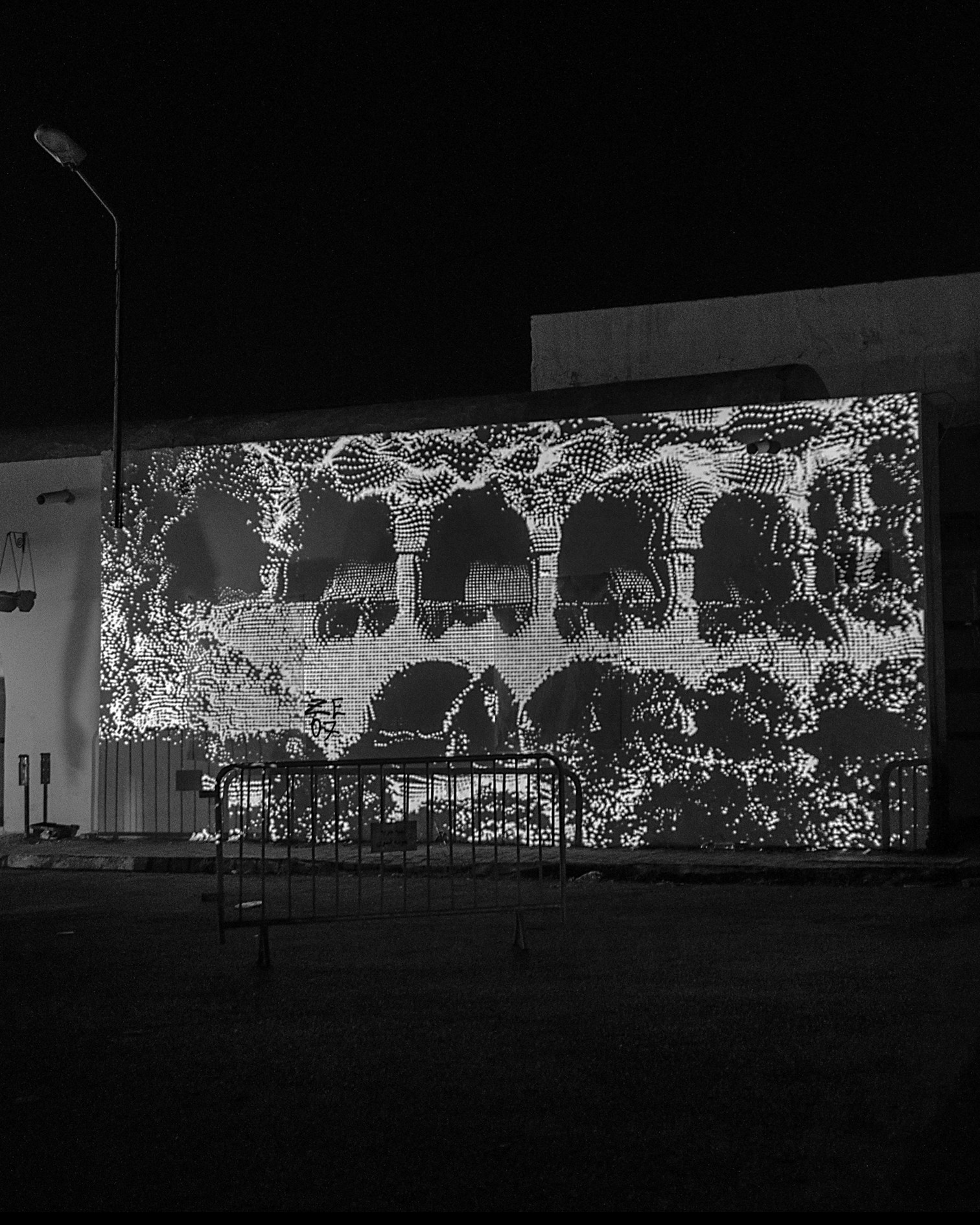
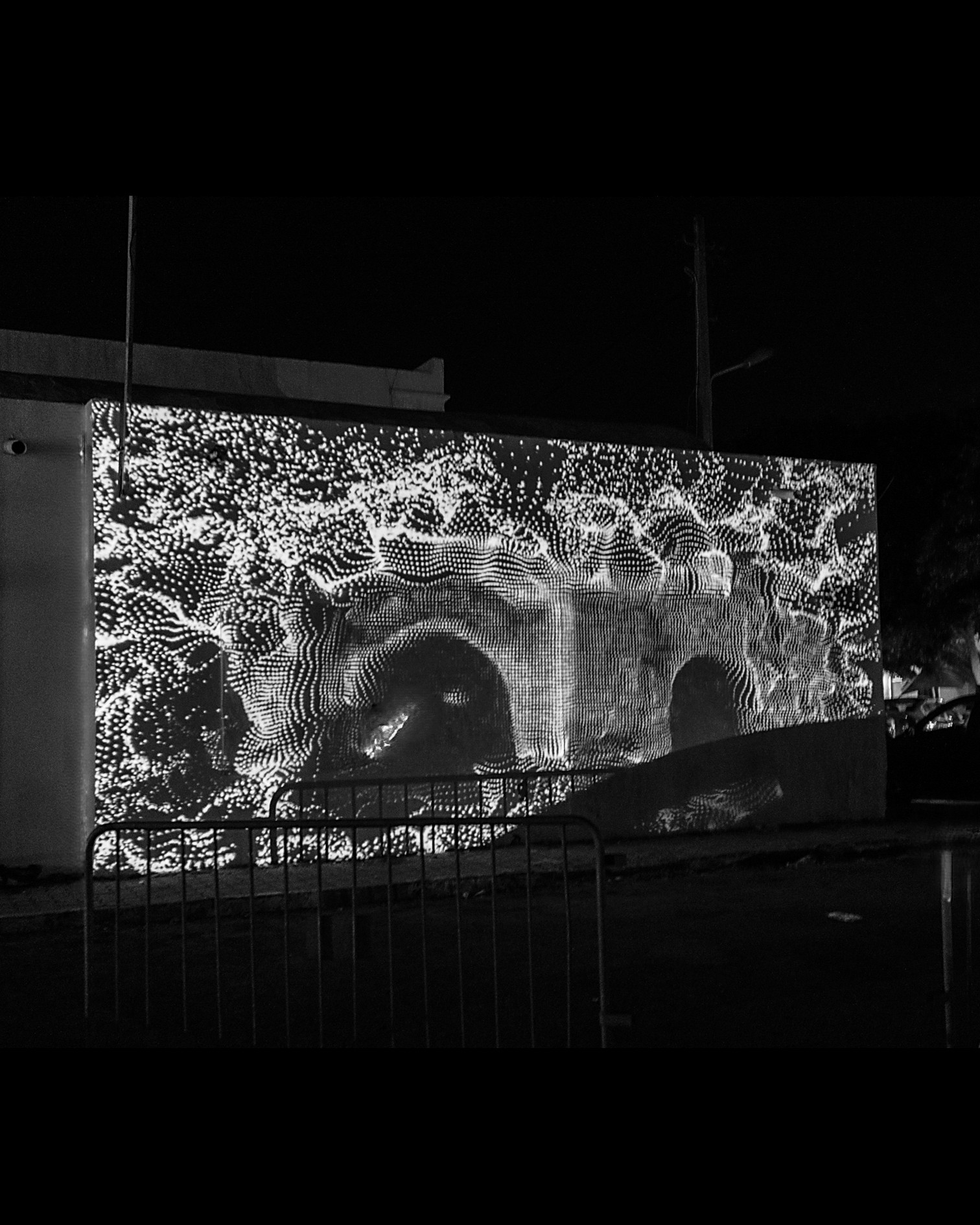
Around Sidi Adulkader Square in Houmt Souk’s center, and in front of the ASSIDJE seat, two sites were selected to present the two parts of Liudmila Siewerski’s animation work. She had turned to the ASSIDJE archive, a vast collection comprising more than 500 historic drawings, prints, and photographs of Djerba, to select some historic images as raw material for her animation work.
Rather than presenting them in their original form, the artist broke them down into the smallest elements in their digital representations: pixels, each no more than a fleeting point of light on a screen. Amplifying this microstructure of digital vision, the pixels drifted and pulsed in sequences of flowing movement, evoking the rhythms of water edging onto sand, sand shifting back toward the sea.
The visuals were supported by abstract soundscapes of water, salt, and sand in motion. In this choreography of particles, figural outlines appeared only to dissolve again, as if the images oscillated between recognition and abstraction, presence and erosion. Viewers encountered a visual vocabulary without fixed borders, where every frame was provisional and every edge porous, recalling how memory itself drifts, reshapes, and cannot be fully contained.




Village Artisanal
FYMA: SAKAN Corporeal Space
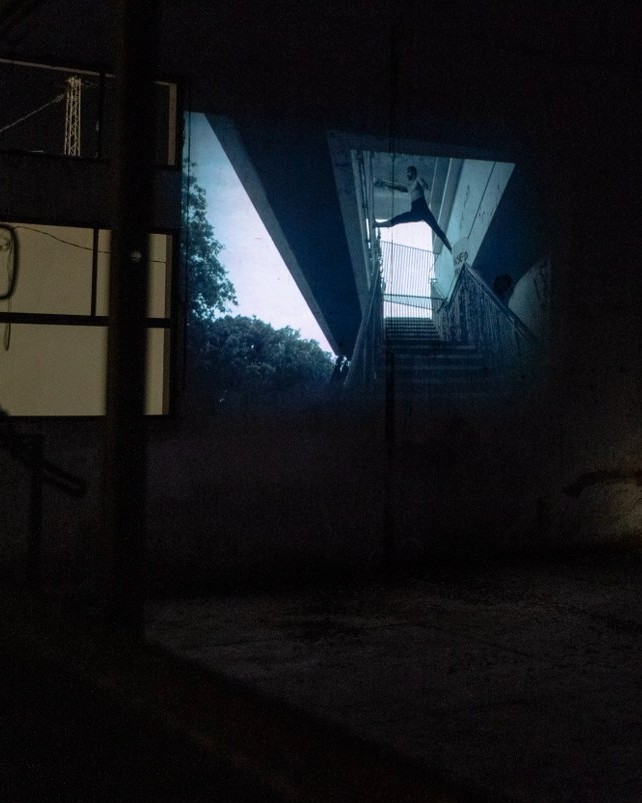
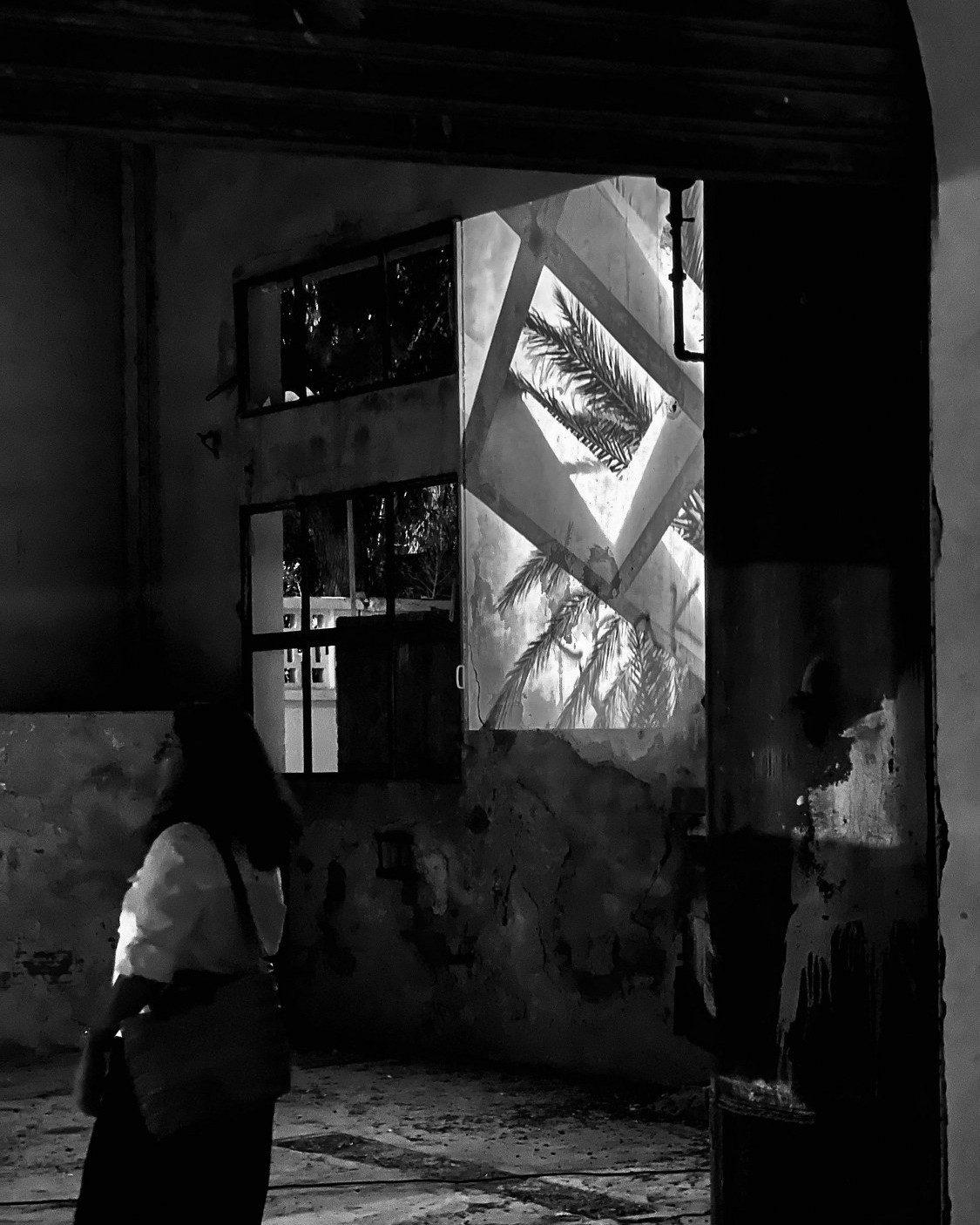
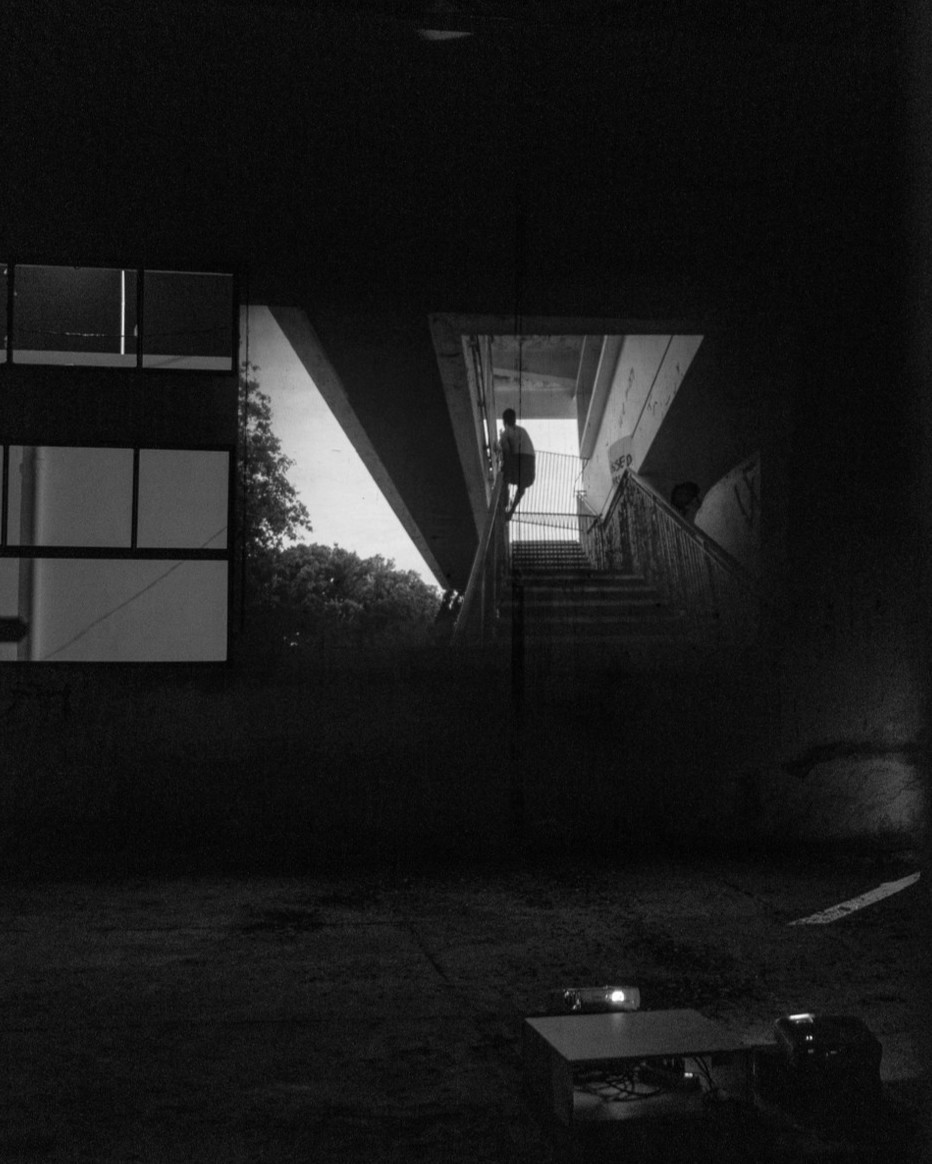
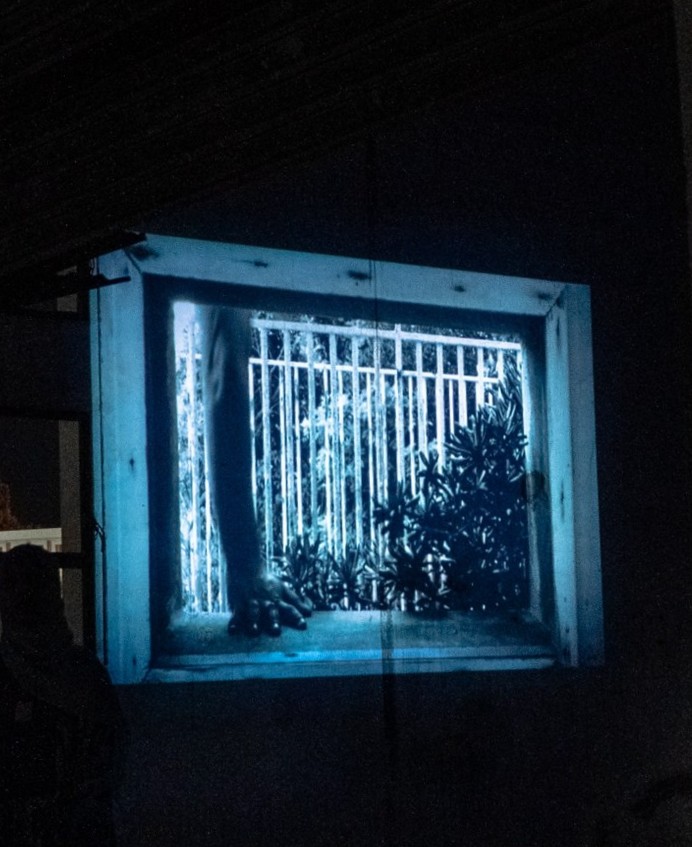
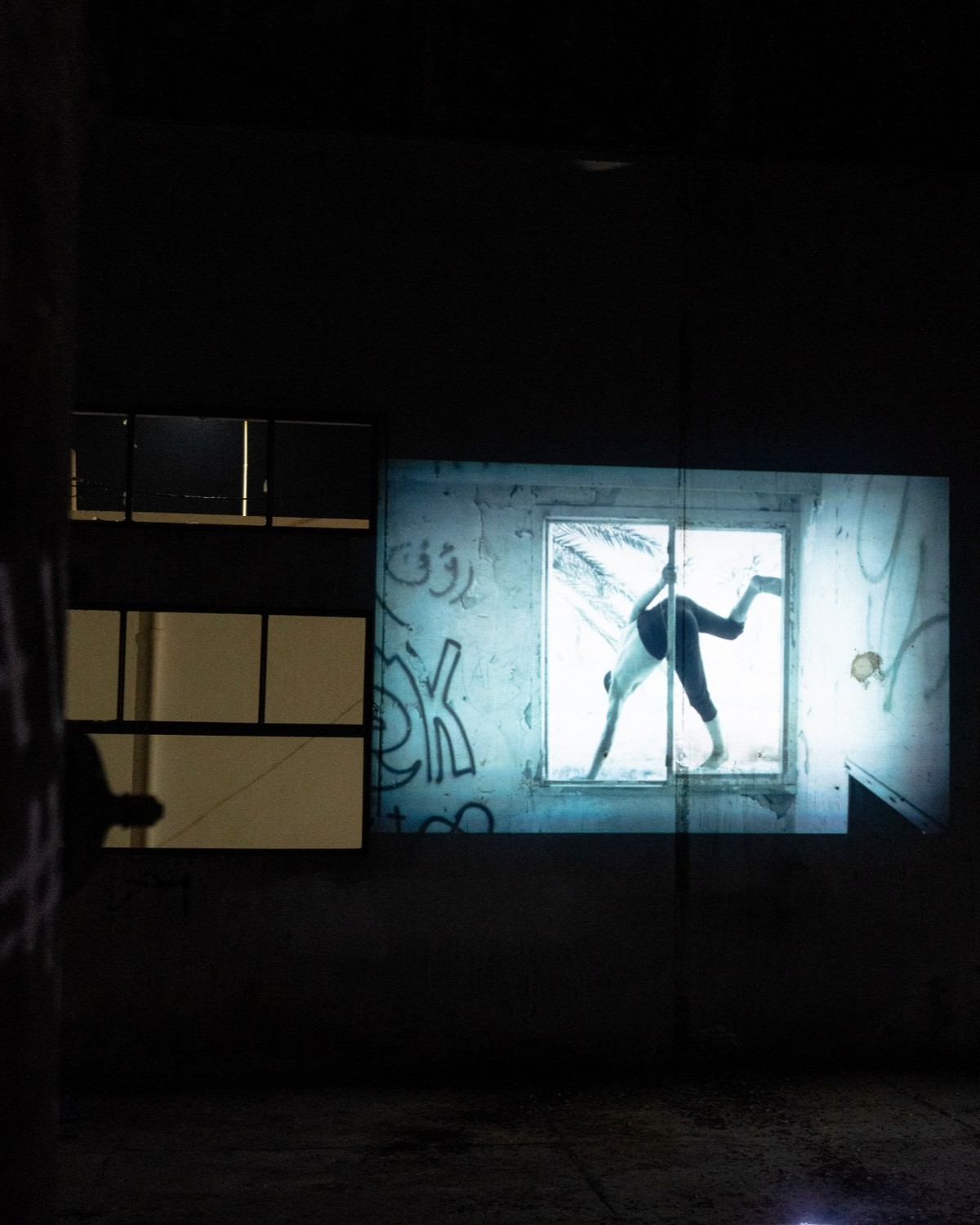
“SAKAN” is a video installation based on footage shot at the Skanès pavilions in Monastir, a modernist complex designed in the 1960s. Originally intended to accommodate the growth of Tunisia’s coastal tourism industry, the pavilions by architect Olivier-Clément Cacoub embodied post-independence modernisation efforts, blending functionalist principles with regional inflections. With their subsequent abandonment, these structures became emblematic of the unresolved legacy of modernist architecture in North Africa.
Located in a decaying space on the grounds of the Village Artisanal, the two-channel installation format reinforced this dialectic between body and architecture. By situating the projections on opposing walls, the installation created a spatial dialogue that enveloped the viewer, mirroring the film’s exploration of resonance between corporeality and structure. The incorporation of site-specific sound elements — including environmental noises, echoes, and the flight of bats — further emphasized the porosity between filmed architecture and the live conditions of the projection space.
Rather than documenting the site as a ruin, FYMA reactivated its spatial and historical potential through a choreographic intervention. Yosri Souissi, the dancer, navigated the remains of the Skanès pavilions in Monastir, using the architectural surfaces as points of contact, resistance, and orientation. The body operated here as a seismographic device, registering both the material traces of a fading architectural utopia and the immaterial presence of past lives linked to the site. The work thus explored the body’s capacity to act as an instrument of memory, transforming the deserted pavilion into a space of temporary reinhabitation.
MISSING REFLECTION: COLONIAL HERITAGE
In community discussions, curatorial debates, and artists’ research, a new aspect that emerged from this year’s edition is the lack of critical reflection of the colonial heritage in public narratives of Djerba’s heritage. Part of the discussion aimed to critically examine Djerba’s layered colonial past, including Spanish and Portuguese incursions, Ottoman governance, and the French protectorate, and its ongoing impact on local identity, culture, and artistic expression. The discussion foregrounded local knowledge, environmental concerns, and vernacular practices, while challenging inherited hierarchies in the presentation of art and heritage.
By providing spaces for learning that integrate local traditions, ecological awareness, and contemporary media arts, SEE DJERBA encourages artists and audiences to critically reflect on historical legacies while developing new modes of expression rooted in Djerba’s cultural and environmental context.
One example of an artwork addressing colonial legacies was “Monetary Mirrors” by Shadi Jafarabadi at the Center for Collective Resources in Djerba (CRAD). Her animation visualized global money flows and the socio-political power of currencies, inviting reflection on how economic systems, values, and identities intersect, while resonating with broader questions of historical legacy, local agency, and the structures that continue to shape society and cultural expression.

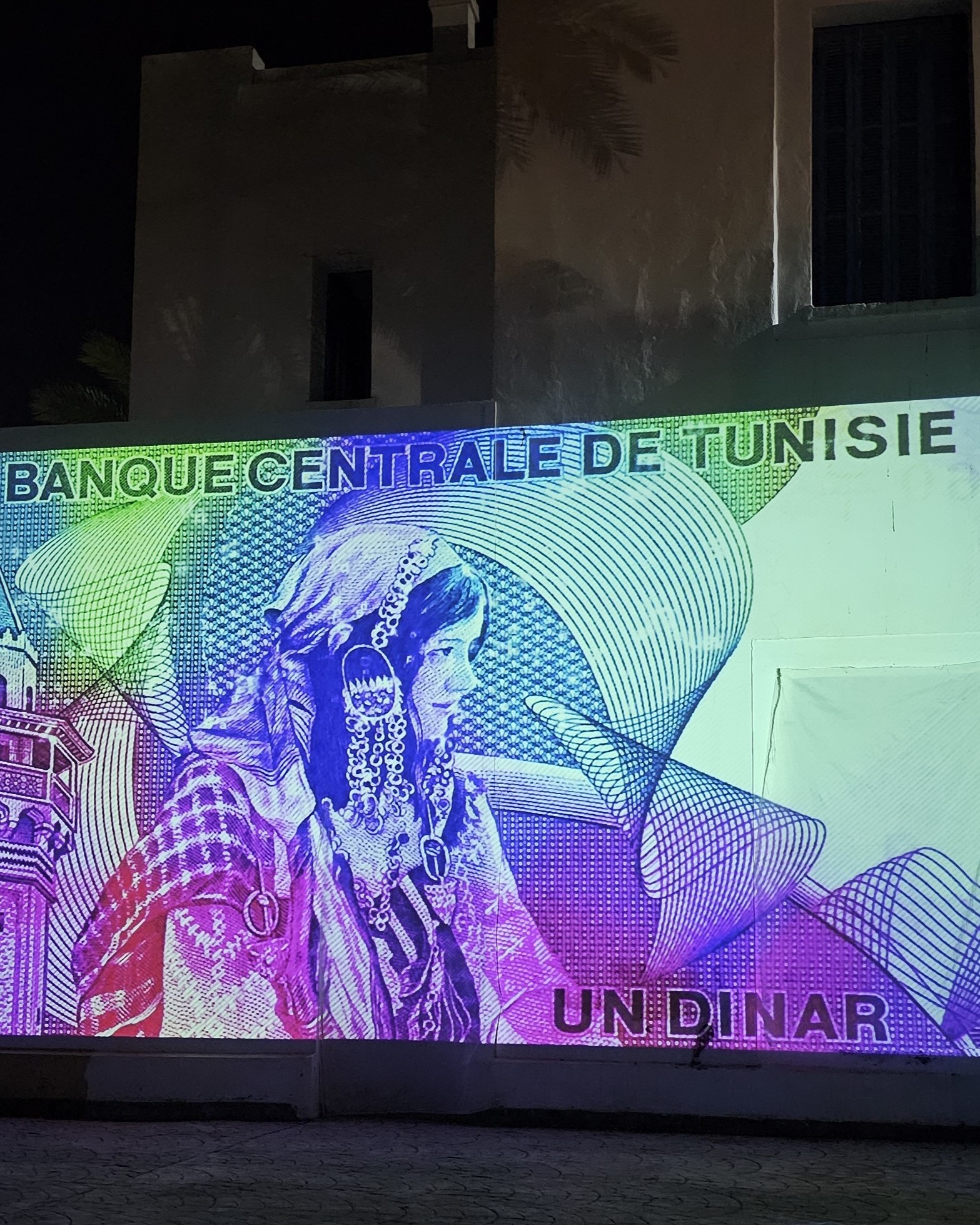


Shadi Jafarabadi: Monetary Mirror
CRAD Centres des Ressources Associatives de Djerba
“Monetary Mirrors” is a projection conceived as a socio-political narrative about values, currencies, and the international network of money flows. The videographic projection told of the global relationships that govern money flows and reflected on how currencies shape identities and manifest power structures. At the center of the work is the development of the modern currency system, with a particular focus on the US dollar as the world’s leading currency. Through graphic animations and video mapping, the work visualizes the rise and fall of value in the global interplay of economy and society. The animations reflect not only the economic but also the cultural and political dimensions of money. For SEE DJERBA, the artist developed a context-sensitive version of the animation.
MISSING RECOGNITION: FEATURING THE AMAZIGH HERITAGE
Another new aspect of the curatorial framework was the recognition of the Amazigh culture in public heritage narratives. Djerba’s cultural heritage ranges from the Amazigh culture, which has been present on the island for more than 10,000 years, to the Arab culture established on the island since the 7th Century. Tunisia’s indigenous inhabitants continue to face notable challenges, despite efforts toward cultural revival following the 2011 revolution, to the extent that Tunisia was considered the North African country where Amazigh identity had been most deeply marginalized.
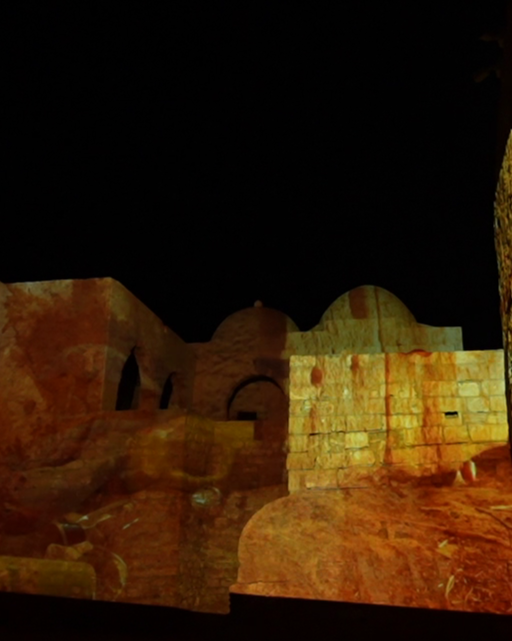
One example is Achref Guesmi’s artwork “The Edge,” which explores Amazigh heritage through his family’s memory, using contemporary digital media. His research involved interviews with family members, which uncovered memories and stories revealing the enduring imprint of Amazigh identity in present generations.





Borj El Kebir
Achref Guesmi: The Edge
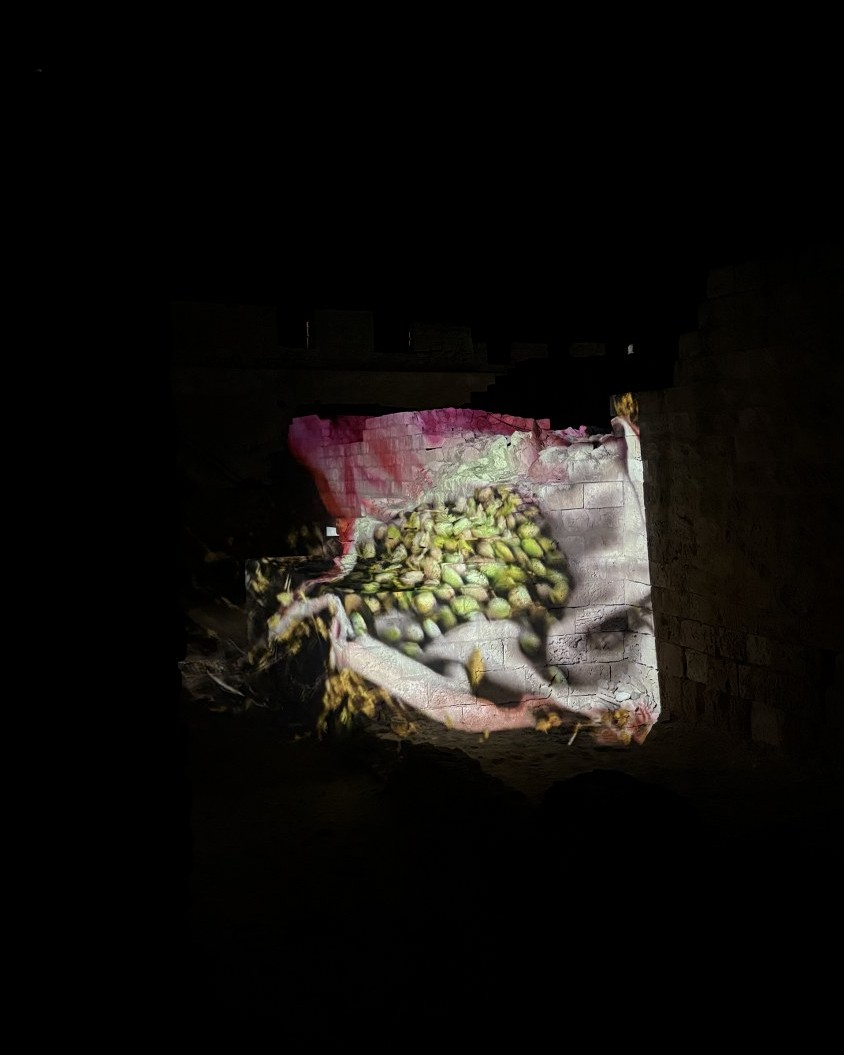
A series of objects, installations, and projections looking into the family’s history and tracing the Amazigh culture. The sequence of interventions consisted of selected objects and documentation footage, audio and visual collages, and projections staged in dialogue with material surfaces. The parcours reflected this inquiry through a series of carefully curated elements that engaged with both the tangible and intangible legacies of the artist’s lineage.
Achref Guesmi’s artwork was set against the backdrop of the Borj El Kebir fortress. Built around 1392, the historic stronghold stood as a canvas colored by the sands of time, its greys, ochres, and roses mirroring the surrounding landscape. The projections and soundscapes were site-specifically adapted and formed immersive spaces, passages of darkness, and evocative soundscapes that invited reflection. From the interplay of the diaphane imageries against the fortress’s weathered stones emerged an atmosphere of thoughtfulness dedicated to the vulnerability of the Amazigh culture, articulated in a new and unique artistic voice.
MISSING RECORDS: REVIEWING THE HISTORY OF POTTERY
The studies of local artist and architect Nour El Ain Najar trace the history of the Djerba pottery. Her artwork was titled “Taghori,” which in Tamazigh refers to a clay oven, pot, or vessel, emphasizing its role in daily life and communal gatherings, since such clay objects were central to cooking and social rituals. Also, “Taghori” can signify either a communal space, reflecting how material culture and social life are deeply intertwined in Amazigh communities. In Djerba, “Taghori Dassah” translates to “strong clay”; it is a key metaphor for the Djerbian identity.
The Amazigh pottery tradition in Guellala is a thousand-year-old art form, known for its rich clay deposits, foot-powered wheels, and unique designs. This ancestral craft, passed down through generations, involves collecting clay, shaping it on the traditional wheel, and firing it to create functional and decorative items, including octopus fishing pots and large storage jars. During her studies, Nour El Ain Najar tried to collect historical records, cultural studies documentation, and art historical assessments, with only limited success. It coincides with the decline of pottery craft in Djerba, from over 400 workshops to around 20 active ones today – open mainly to feed the touristic narrative and predominantly without referencing the Amazigh culture. In her large-scale projection, Nour El Ain Najar linked her family’s heritage, her academic studies, and her observations on current developments.






Village Artisanal
Nour El Ain Najar: Taghori
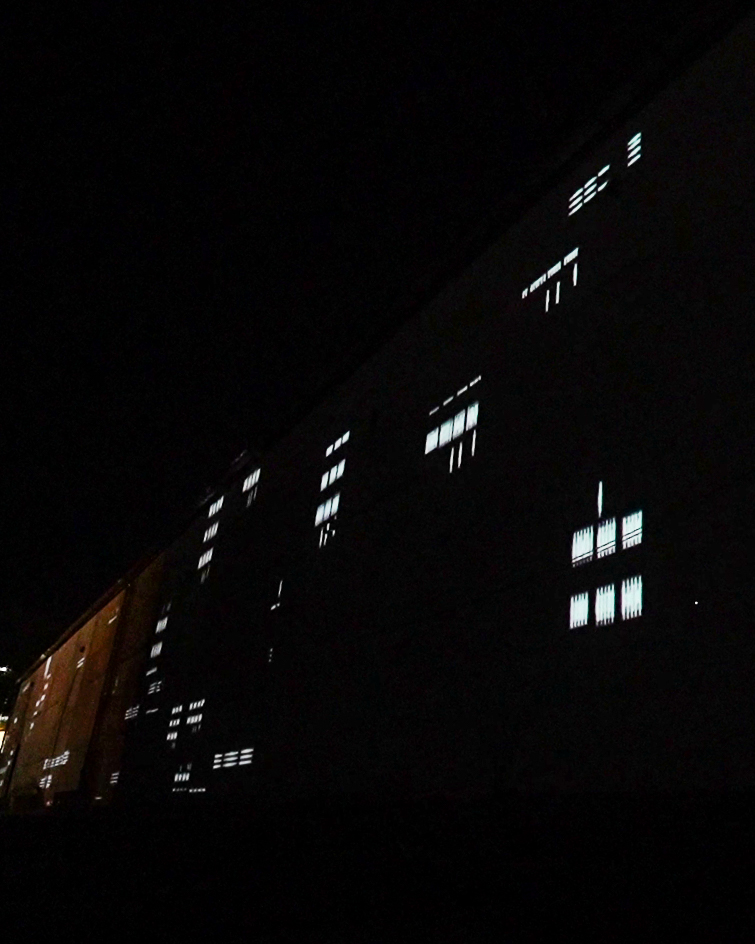
Nour selected the center courtyard of the “Village Artisanal” as her site, a modern complex on Avenue Habib Thameur with shops and workshops for pottery, textiles, and metalwork, promoting local economy through tourism.
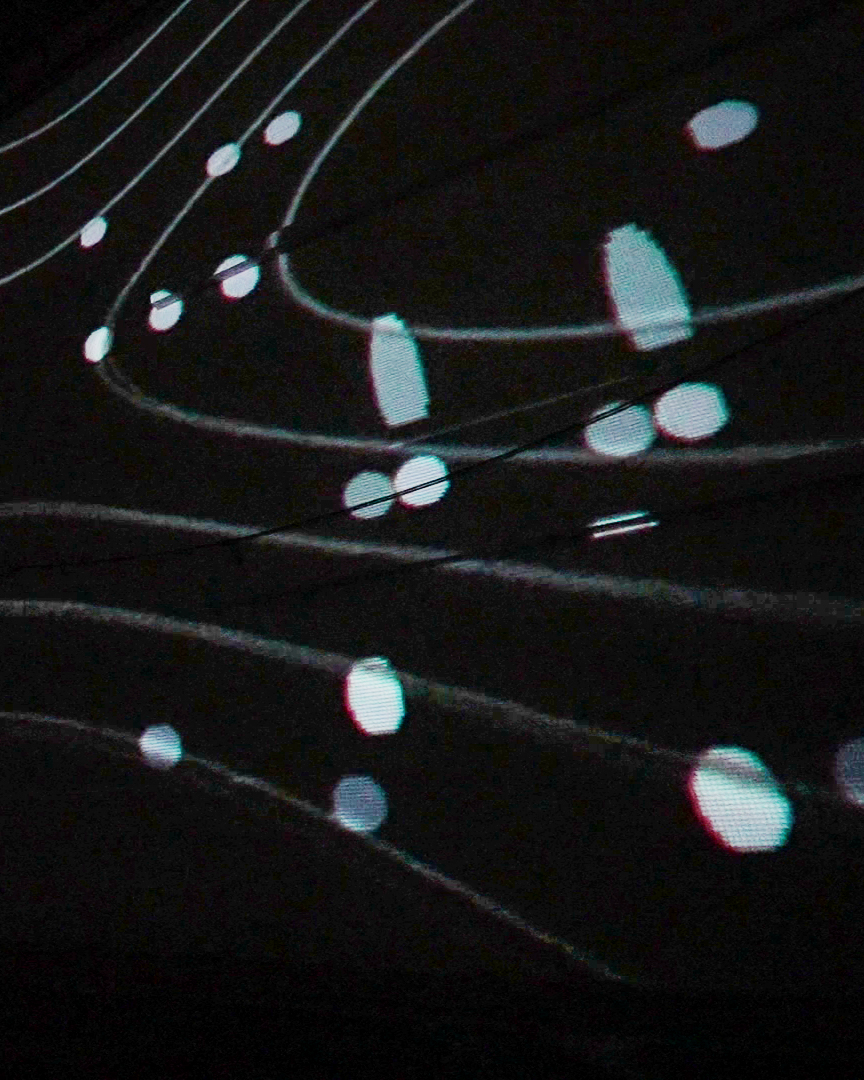
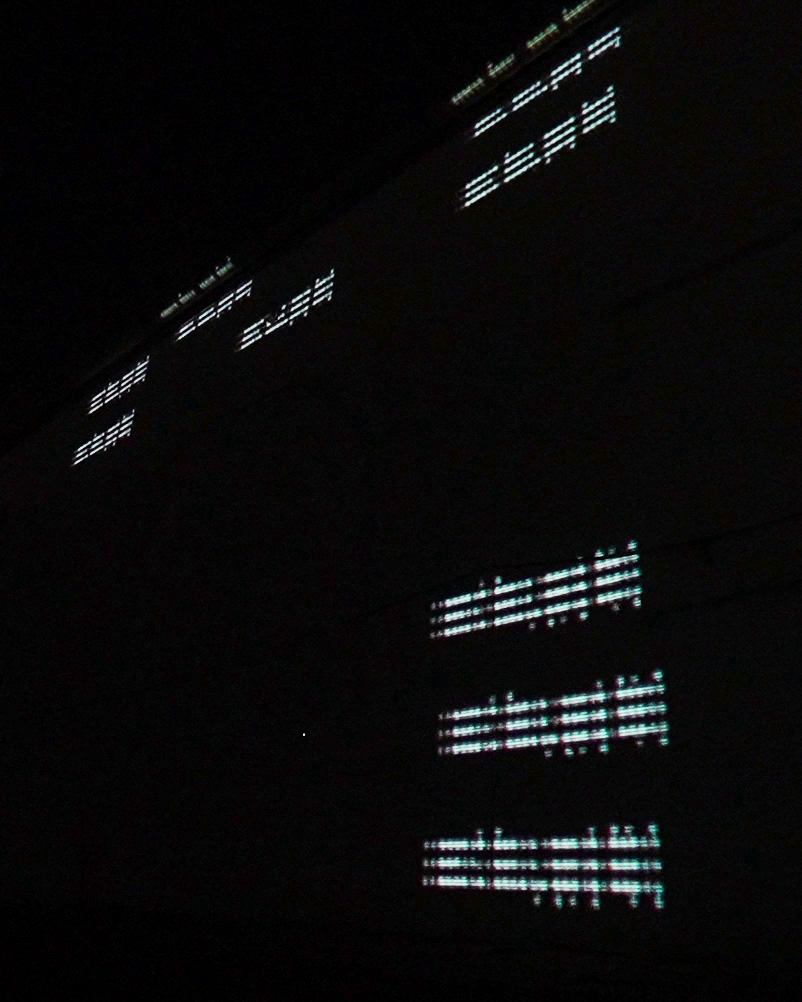
Her root materials were archaeological records and architectural drawings of the pottery workshops as part of the “menzels”, the traditional Djerban dwelling and agricultural compounds, which combined homes with orchards, fields, and infrastructure such as wells or cisterns. In architectural plans of Djerbian pottery workshops, squares and circles represent the working space (square) and the oven (circle). For the animation, Nour experimented with graphic materials such as lines, symbols, and their spatial formations. She decided to add text, set in the Kvadruk font, in which combinations of squares and circles represent letters.
The poem, set in the Kvadruk, served as the raw material of the animation, singled out as elements or woven into structures or words, straight or distorted, still or moving. They expanded and collapsed, multiplied, overlapped, and dissolved. Nour composed a visual stream that contained information, but couldn’t be read. She developed an unreadable visual narrative to refer to the missing records, interest, and the disappearing craft of Amazigh culture.
She chose a line from a poem by Sheikh Naji Bin Ali Al Hadri to be added: “Even if it merged again with the clay and united with the water, sinking into it, it will rise as light.” Jamel Ben Maamer read the poem in Tunisian Arabic and Chelha Amazigh; his voice-over accompanied the graphical stream of information.
The audio-visual composition, featuring graphic materials from architecture and design, contemporary animation techniques, and a soundscape encompassing Amazigh and Tunisian vocals, was merged into a panoramic projection across the entire courtyard.
MISSING MEMORIES: INCLUDING THE CULTURAL HISTORY OF MIGRATION
In the present-day mass migration across the Mediterranean, another curatorial aspect was to explore the island’s migration history. Djerba’s history reflects its role as an island sanctuary that accommodated refugee populations, contributing to its rich cultural and religious diversity. The island has historically served as a haven for people of diverse cultural, geographic, or religious backgrounds.
One of the present-day landmarks is the Maltese Quarter, a specific area in Houmt Souk where people of Maltese origin have historically lived. This community established itself in Djerba primarily in the 19th and early 20th centuries, when many Maltese people migrated to Tunisia in search of economic opportunities. The Maltese migrants were involved mainly in trade, fishing, and sponge fishing, and they contributed to the island’s diverse cultural and social fabric. They settled between the old town center and the harbor, over time forming the “Maltese Quarter”. The architectural layout and style diverge from the local Menzel system, featuring building forms and public spaces inspired by Maltese and southern European models, with a more open orientation to the street.
The Fondouk Malti is one of the historic socio-cultural meeting points of the Maltese community, linking past migration movements to present-day migration. It hosted the artwork of the Maltese tandem Ponks, which referenced the Maltese migrants; the video installation by Skander Cherif, which expressed the emotional turmoil of preparing for their migration, meandering between legal and illegal options; and the interactive projection mapping by OBK, which turned the facade into a living canvas.


Ponks: Ritual
Fondouk Malti
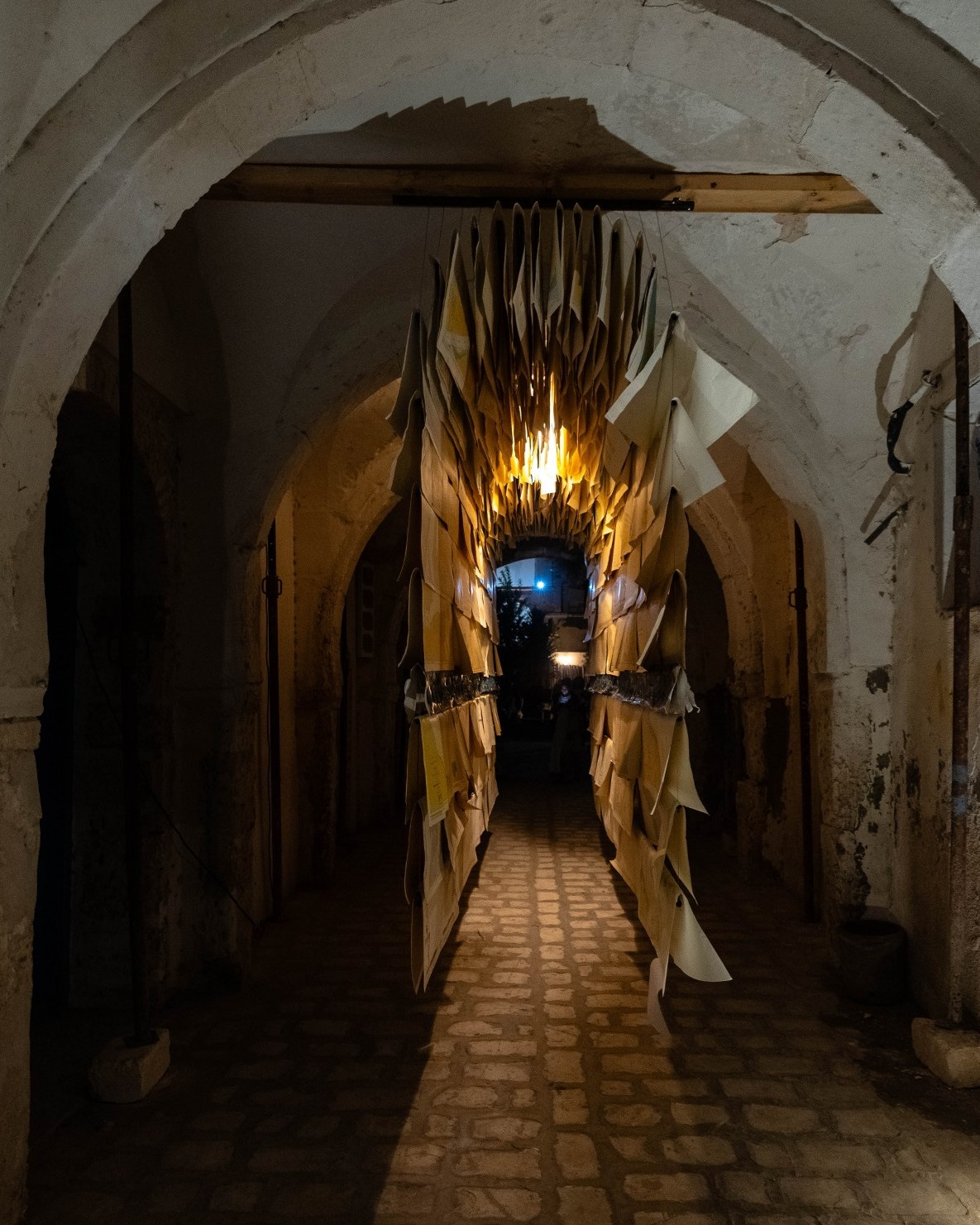
With “Ritual”, the duo Ponks created a meditative passage in which geography, history, and human stories converged, offering a poignant tribute to the Maltese diaspora and their lasting imprint on Djerba. Situated within the entrance passage of the Fondouk Malti, the gateway between the old town’s heart and the Maltese Quarter, Ponks’ “Ritual” installation evoked the profound history and enduring legacy of Maltese migrants in Djerba.
The installation “Ritual” utilized old maritime charts as building materials for a sculptural environment that transcended their traditional cartographic role. Rather than mere geographic records, these maps became narrative and symbolic vessels that explored themes of migration, identity, and the complex politics of borders.
Suspended in space and folded midway, the charts formed layered, undulating surfaces reminiscent of shifting coastlines and ocean waves — both visually dynamic and deeply metaphorical. Interlaced with these maritime maps were translucent sheets crafted from cured glue, delicately painted to capture and filter ambient light. Upon these fragile surfaces, poetry was sewn as fine threads, embedding intimate narratives within the installation. The delicate interplay between the tangible textures of the maps and the ethereal glow of the poetry invited viewers into a contemplative space.


Skander Cherif: Threshold
Fondouk Malti
“Threshold” by Skander Cherif is a powerful video essay that explores the emotional torment and psychological toll of navigating national and international visa systems that control mobility and access to opportunity. It ponders on the deeply felt barriers shaping lives and mobility.
The video incorporates black-and-white inverted imagery of Tunisian passports, visa centers, waiting lines, and newsrooms, juxtaposed with disruptive soundscapes of electronic tools. These visuals are collaged with scenes of migrants undertaking illegal journeys, partially filmed en route or depicted in the news. Text fragments in the work accuse denied visas of propelling people into dangerous crossings through deserts and seas, exploitation, and even death. Lighting effects over open water, scenes of running trains, and pixelated imagery intensify the sensations of exclusion imposed by borders. Skander employs pixelation, glitch, distortion, collage, and overlay techniques to create a layered and complex visual narrative in “Threshold”. This approach evokes disorientation and fragmentation, mirroring restricted mobility and systemic obstacles that deny access to opportunities. The piece carries the powerful statement: “My art is the only way to survive.” – not only as a personal statement, but one of an entire generation.



OBK: The Sun
St. Josephs’s Church
The St. Joseph’s Church is one of the well-kept buildings, while other parts are somewhat neglected and rundown. By merging cosmic imagery with real-time human interaction, the work not only reimagines the church façade as a living canvas but also highlights the potential of art to foster shared experiences, awareness of collective energy, and a deeper connection between people, place, and the cosmos.
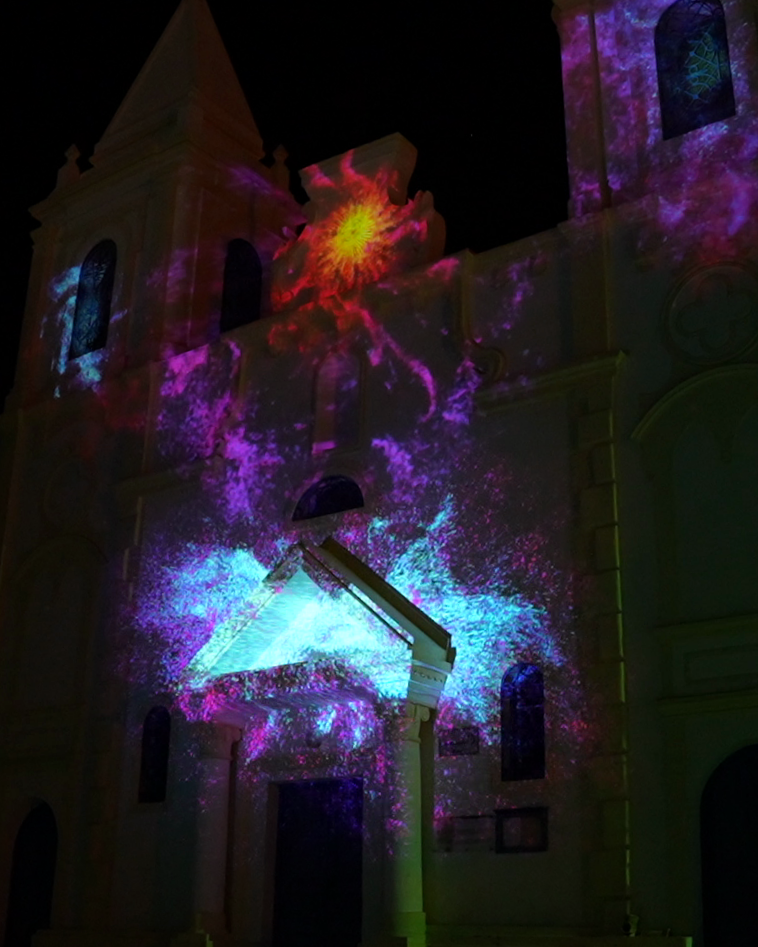
Projected onto the historic façade of St. Joseph’s Church in Houmt Souk, OBK’s “Sun” was an interactive digital intervention transforming the building’s mid-19th-century architecture into a canvas for storytelling. On the limestone surface, four stellar forms are composed of spinning, energy-rich centers that generate continually shifting fields of color and particles across large-scale, two-channel projections.
Three of these radiant bodies, situated high across the twin towers and upper façade, are pre-recorded animations; a fourth, positioned above the main entrance, unfolds live in real time, its evolving form responding to the gestures and movement of passersby, tracked by a Kinect sensor. As visitors move, their presence shapes and animates this digital “sun,” forging a dialogue between cosmic evolution and collective human energy.
MISSING INFORMATION FOR SUSTAINABLE CHALLENGES
A new aspect of the 2025 edition is the challenge of handling fragmented data and the lack of interdisciplinary cooperation. Environmental and socio-cultural activists in Tunisia face a significant gap in documentation, research, and reliable information, which undermines their ability to develop informed, effective, and sustainable initiatives.
Comprehensive data, historical records, and scientific studies are essential for understanding ecological systems, social dynamics, and cultural practices. Without these resources, it becomes difficult to assess current conditions, anticipate future impacts, or design strategies that balance environmental protection, cultural preservation, and community well-being. Neither activists nor artists can respond to challenges like climate fragility, cultural erosion, or the preservation of Amazigh heritage without access to scientific and technical data. Open collaboration with scientists, environmental engineers, and activists, such as hydrological records on Djerba’s water scarcity, soil analyses for heritage sites, or ethnographic datasets on local cultures, is essential for art that meaningfully engages with ecological and socio-cultural crises.
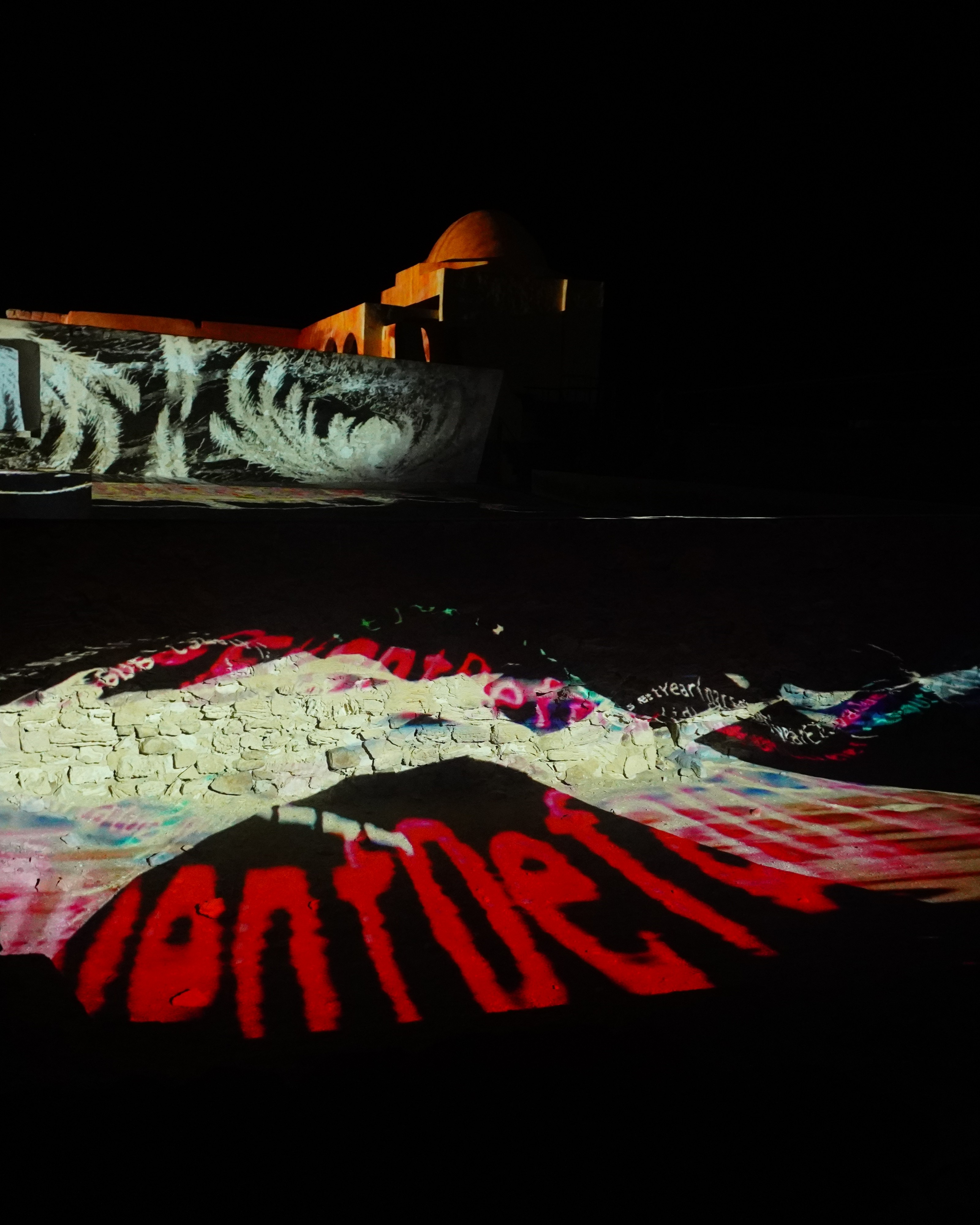
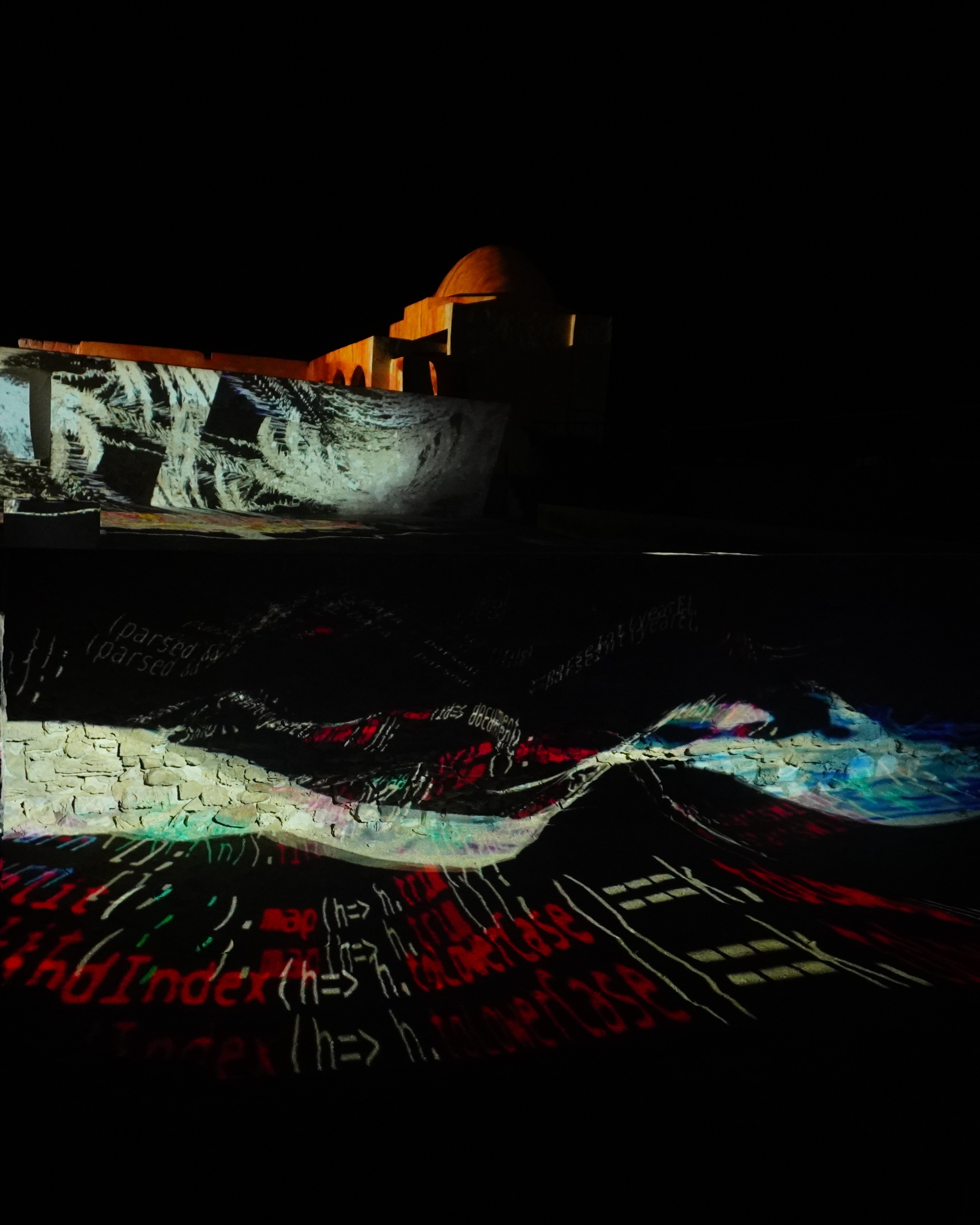
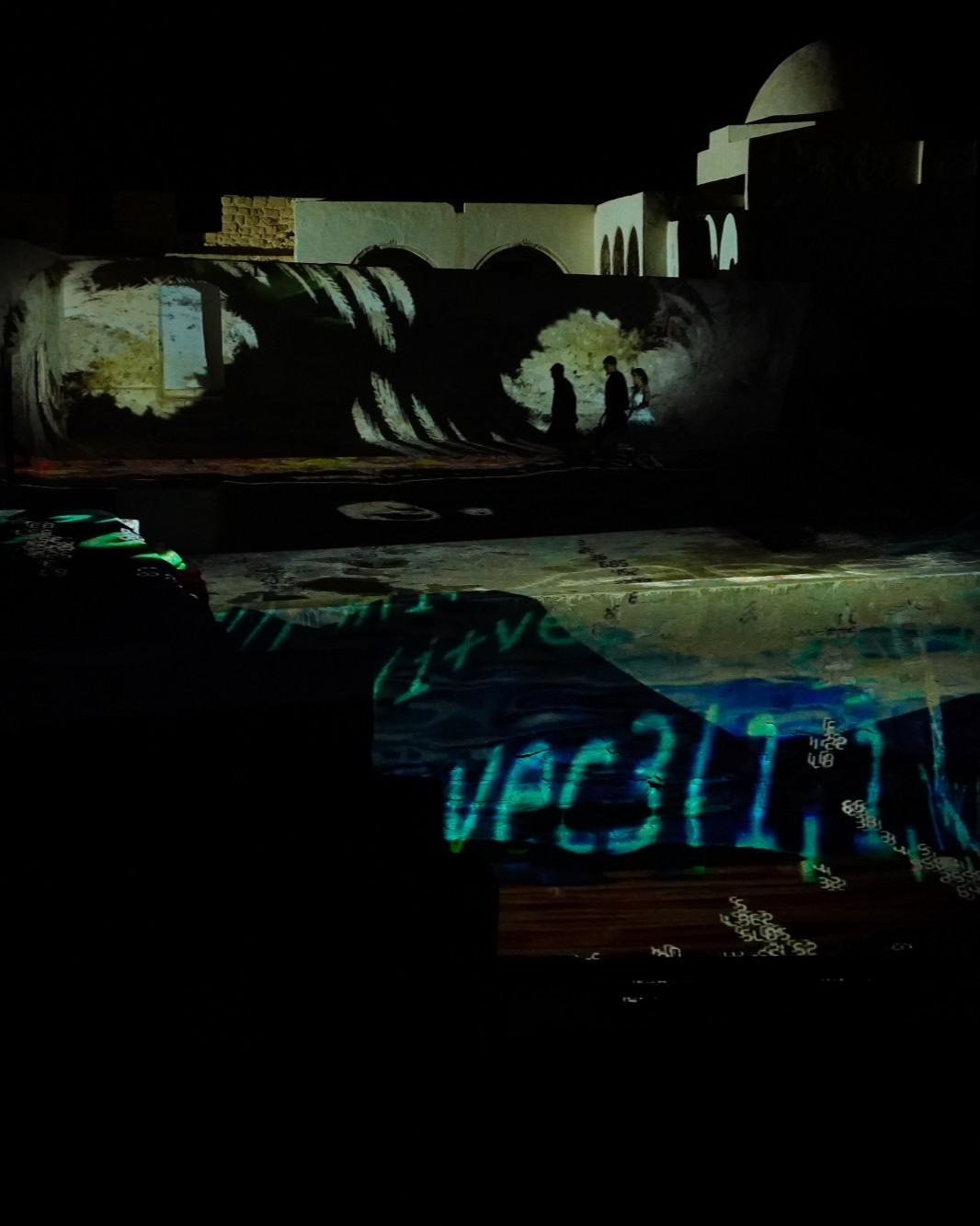
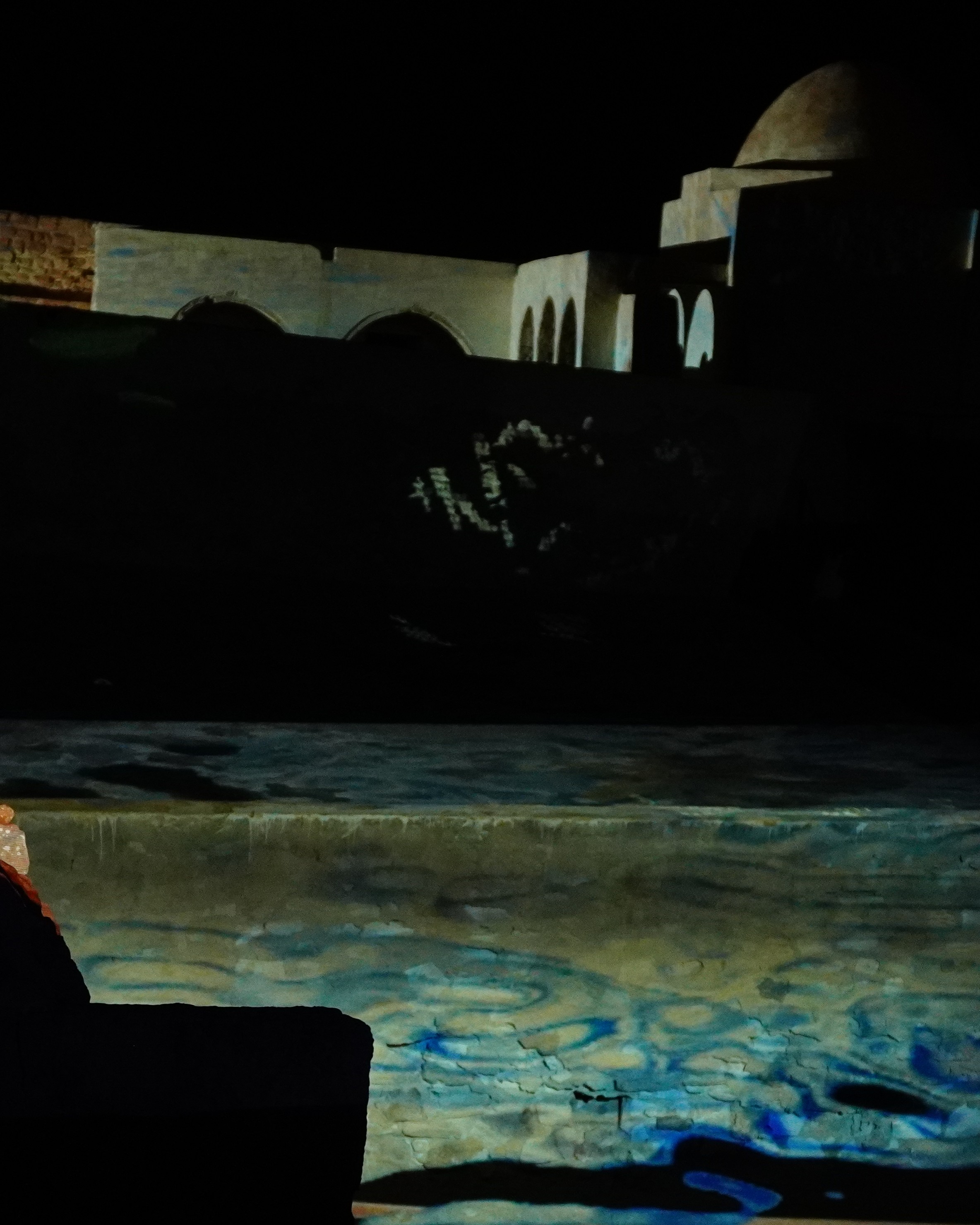
In her research on water scarcity in Djerba, Zeineb Kaabi encountered the scarcity of data. Missing or inaccessible records about the island’s water resources became a revealing fact, prompting a dual reflection on environmental and informational drought. She developed an experimental animation of text, sheets, graphs, and gaps, as well as incomplete photos, illustrations, and other visual records. In the animation, the stream of data dissolves, disappears, changes color, and composition.
She selected the central courtyard of the Borj el Kebir, above the fortress’s underground water supply system. While the current accessible documentation provides no detailed description of internal wells, cisterns, or a self‑contained hydraulic network within Borj El Kebir, the local team provided fragmented information that informed her animation.




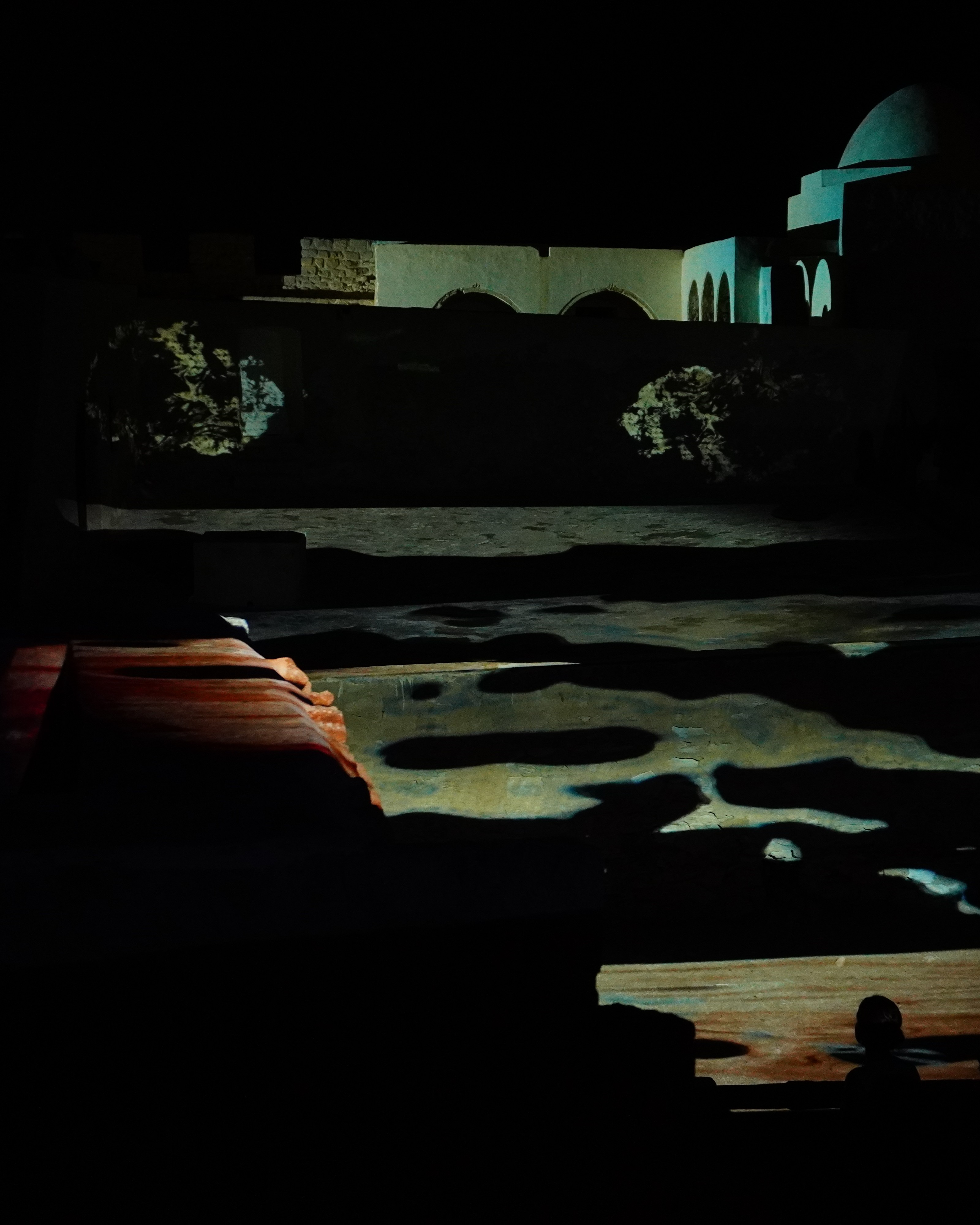
Zeineb Kaabi: Liquid Silence
Borj El Kebir
With “Liquid Silence”, Zeineb Kaabi presented an immersive exploration of form, data, and perception, transforming the central courtyard of Borj El Kebir into a dynamic, site-specific environment. Kaabi’s work intertwined drawings of trees, lines of numbers, text-based structures, and geometric pattern graphics, projected across the weathered stone surfaces of the historic fortress.
Divided into multiple areas and elevations, the installation engages with the courtyard’s architectural contours, creating a layered experience of texture, depth, and height. High-contrast projections animated the surfaces, moving in ripples and waves reminiscent of water, shifting colors and visuals to evoke continuous transformation.
The walk-in installation reflected the lack of data and its unreliability; the sequences evoke gaps, interruptions, and missing information. Each moment altered the viewer’s impression, reflecting Kaabi’s meditation on fluidity, structure, and the interplay between natural and abstract, visual and scientific systems.
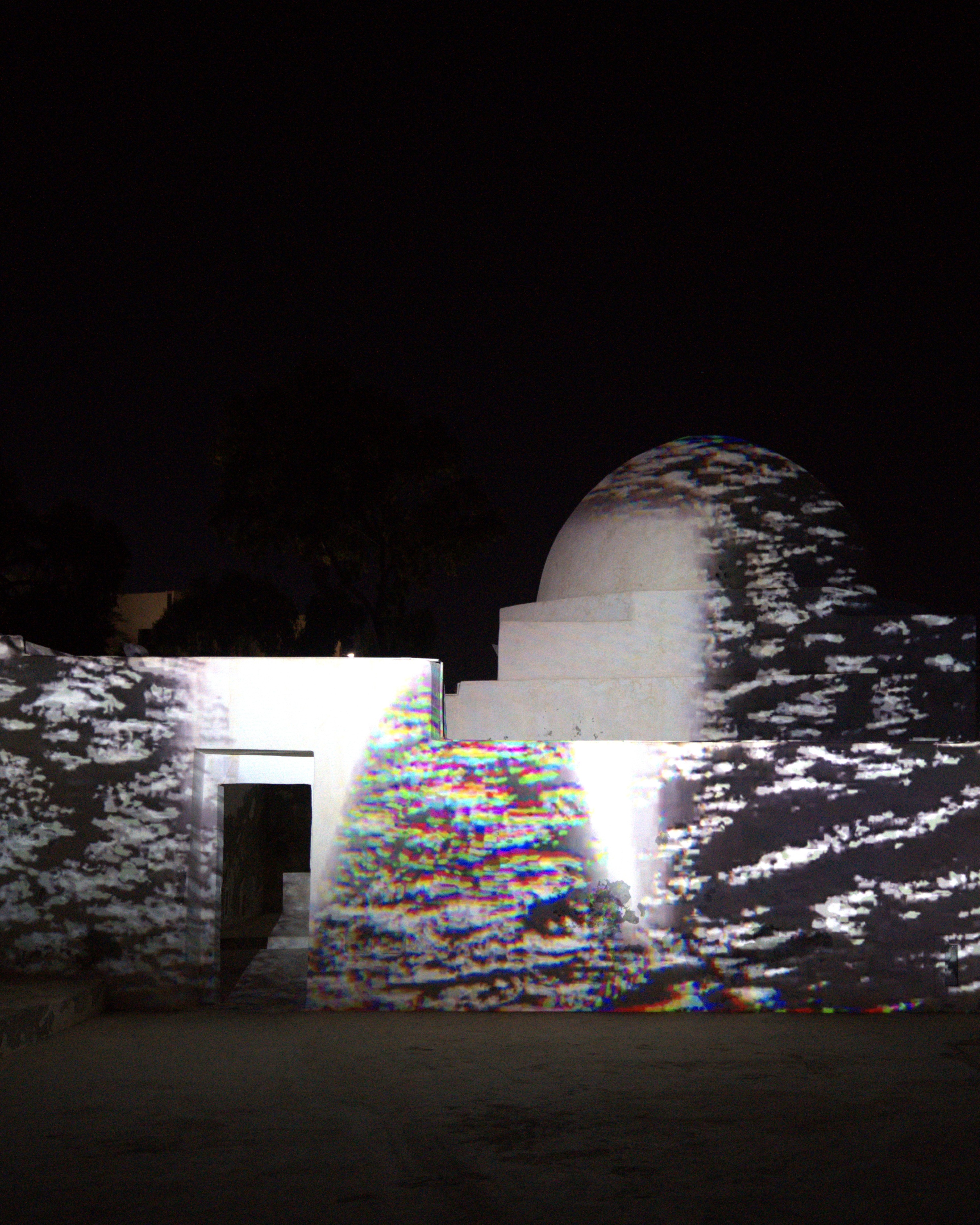


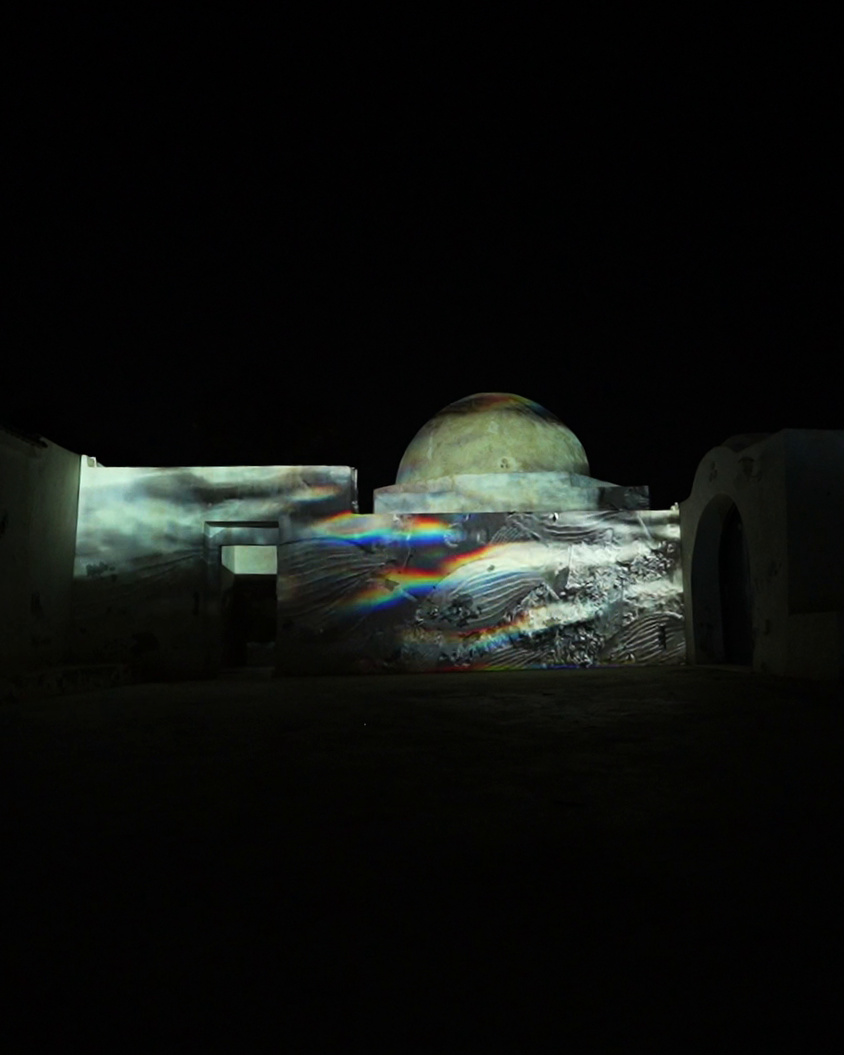


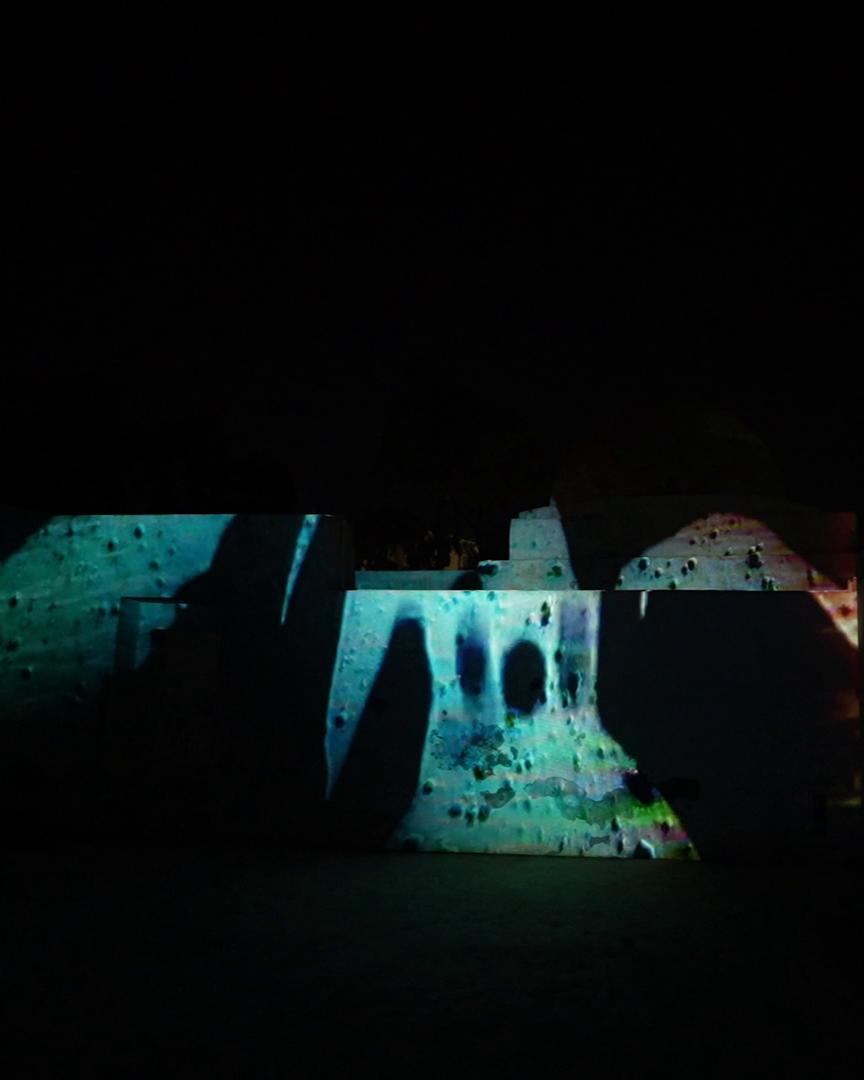
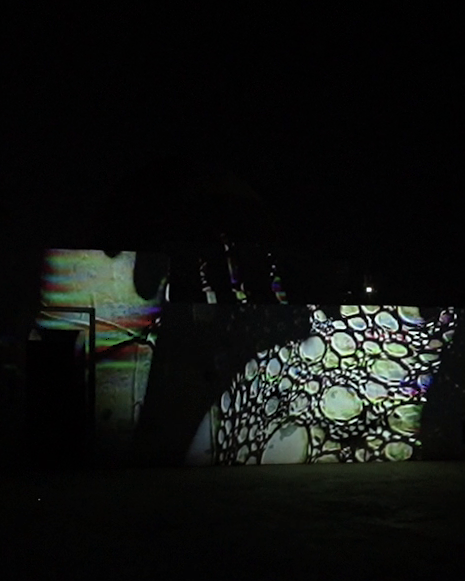


Camilla Angolini & Ahmetcan Gökçeer: LITP
Museum
Camilla Angolini and Ahmetcan Gökçeer embodied the principles of transdisciplinary cooperation by merging scientific observation, digital technology, and artistic experimentation into a single, immersive work. The “LITP” video projection extended across two inner courtyards of the museum. In dialogue with the exhibition context in Houmt Souk, the artwork incorporated the chromatics of the environment and spatial textures: The bleached white walls and weathered surfaces of the museum interwove with the projected images.
Transparent layers superimposed water surfaces with luminous reflections, substances in petri dishes in transformation, film particles, and shadow images of moving hands. All elements were in a constant state of flux, changing from liquids to color structures to digital textures characterized by distortion, interference, and transience.
The interplay of image and sound was designed as a reciprocal system. The diaphanous image layers oscillated through a sound continuum of glass-like resonances, electronic distortions, and micro-acoustic shifts. By pairing these visuals with a dynamic soundscape of resonances, distortions, and micro-acoustic shifts, the work created an integrated sensory system where technology, environmental observation, and artistic expression converged.
ROOTED IN PERSONAL EXPERIENCES
Artistic research and critical reflection on personal memory were central to the conception and presentation of some of this year’s artworks. Several projects examined the reciprocal relationship between individual memory and cultural heritage, situating personal experiences within broader collective narratives and demonstrating how diverse perspectives and life trajectories can shape, reinterpret, and transform shared histories and legacies. In addition to visual data and documentary materials, artists explored embodied forms of memory, investigating how bodily awareness and movement function as sites of remembrance and knowledge.


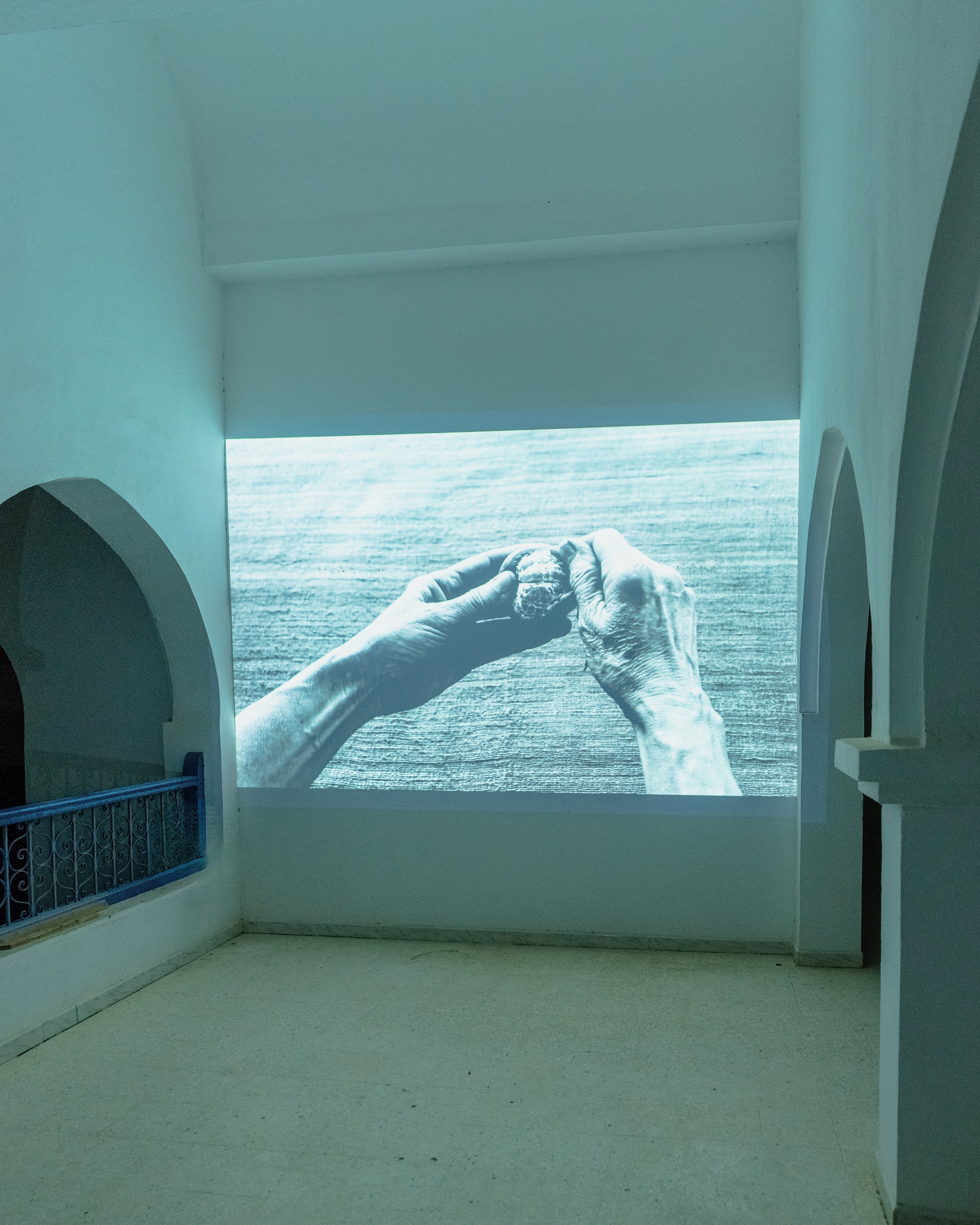
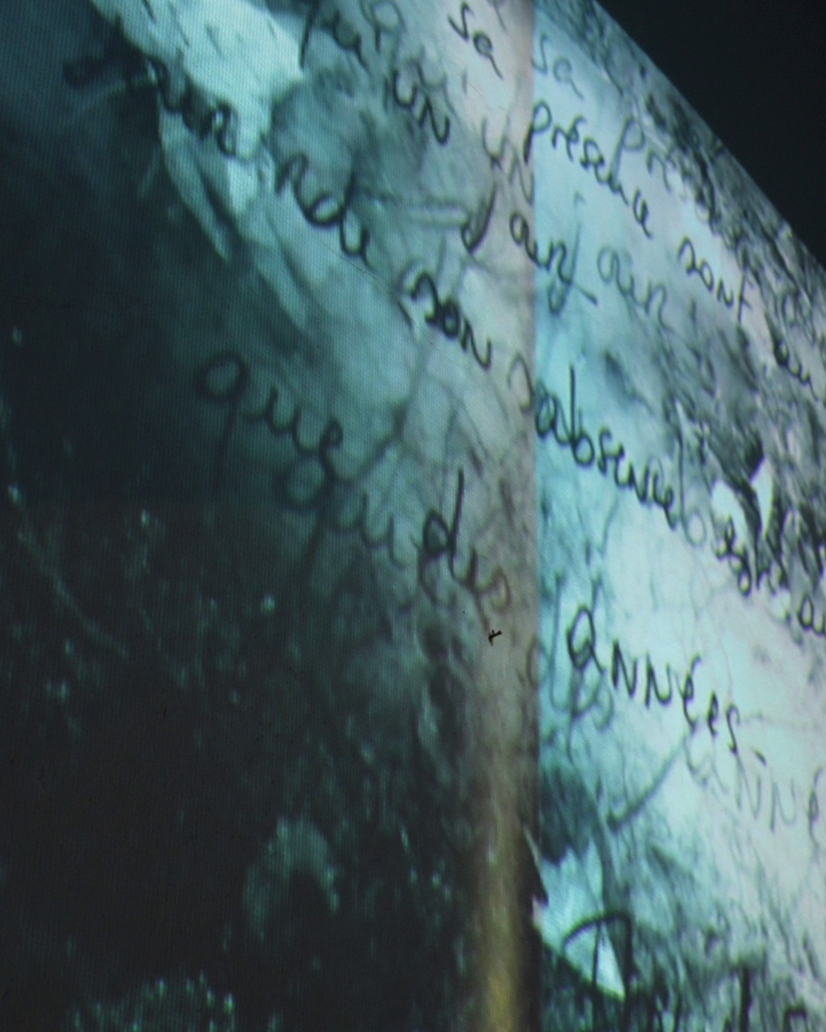


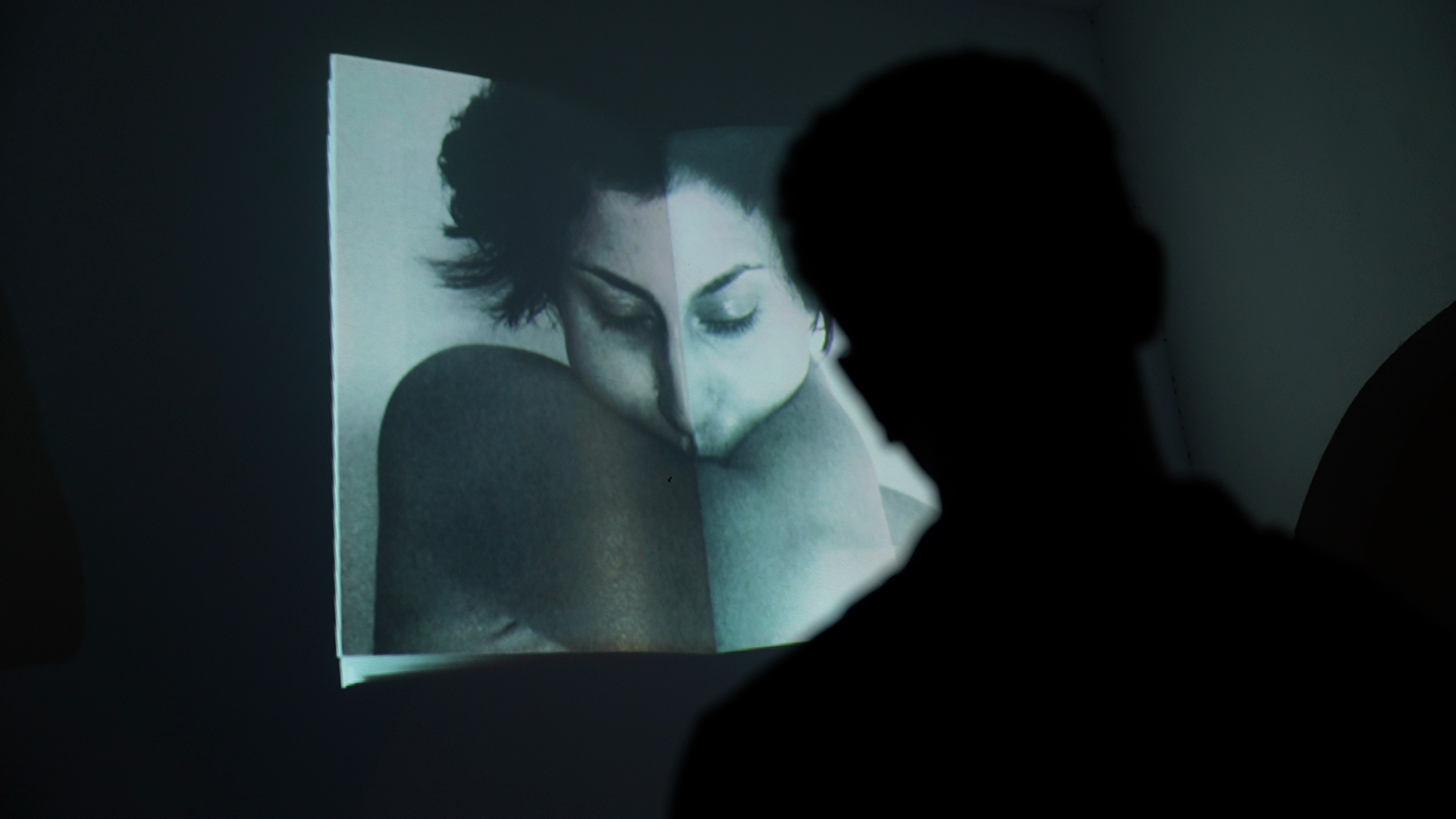


Maya Louhichi: Et dans la terre, je me souviens & Gestes Quotidiens
Village Artisanal
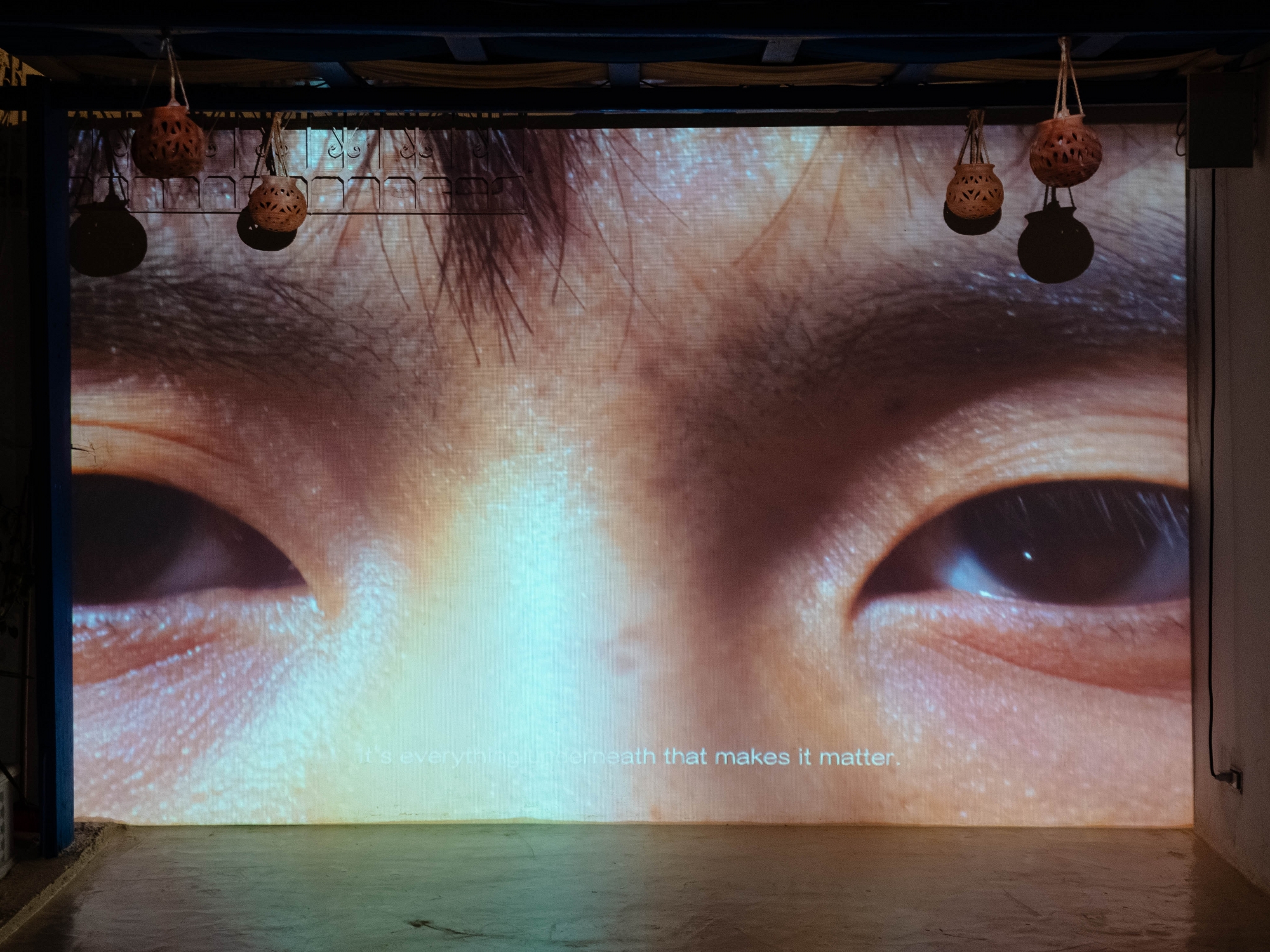
The upper galleries in the central building of the “Village Artisanal” were dedicated to two video essays by Maya Louhichi. The atmosphere was quiescent, and light was emitted only from the projections installed in parallel across the courtyard.
The two artworks are a testament to familial ties, belonging, and identity, as well as the transmission of what endures across generations. They offer a microscopic view into transience, mourning, and loss, unfolding with sensitivity to the fragile and impermanent, and expanding into an artistic language.
Both artworks were dedicated to the artist’s father, one of them thematized the father’s loss of motor skills after an accident in 2006, and the other is based on an archive of photographs that Maya inherited after his death. Loss and grief are portrayed as shifting terrains, and photography emerges as a tool for holding and releasing, reflecting and tracing, and a continued negotiation between the past and the present.
“Et dans la terre, je me souviens” is a visual dialogue of images that trace the themes, the way of seeing, and the impact of the camera in the father’s archive, juxtaposed with visuals authored by Maya. For “Gestes Quotidiens”, the artist asked her mother to perform all the daily gestures of her father that she remembers years after he was paralyzed.


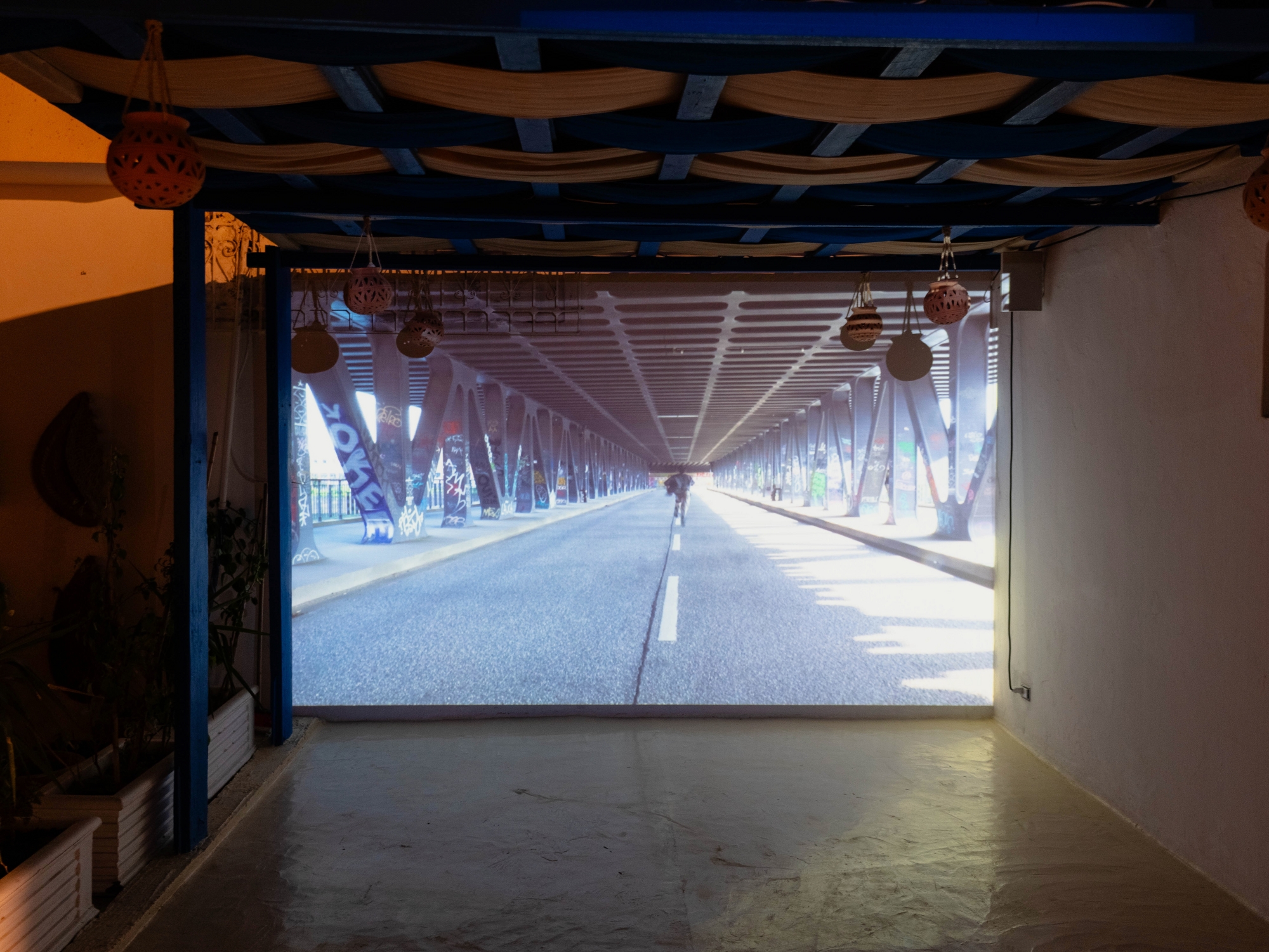


Merve Can: The Story Behind the Jump
Fondouk Bouchaddakh
The video essay frames breakdance not as a fleeting performance but as an embodied cultural transmission, in which physical memory encodes histories of body and space, experimentation and exploration, training and resilience.
In the courtyard of Fondouk Bouchaddakh, another of the many historic fondouks in Houmt Souk, housing artisan workshops and a modern café, Merve Can’s video essay unfolds on the outdoor terrace of Café El Ghorba. This projection transformed the caravanserai into a living stage for breakdance as embodied inquiry.
In the video, a breakdancer navigates the textured urban space, tracing materials through mindful touch and fluid experimentation, revealing spatial resonances and rhythmic repetitions. The camera shadows these gestures in constant motion, heightening the viewer’s kinesthetic immersion as if pulled into the dance itself.
A voiceover pierces the scenes, narrating the unseen discipline, the hours of training and passion that forge an effortless response to architecture and air. At the same time, a soft hip-hop jazz underscore builds an atmospheric pulse. This layered narrative frames breakdance as coded ritual: a tool for self-assertion, discovery, and reading space through lived experience.
WATER AND EARTH
SEE DJERBA’s curatorial focus has evolved through thematic lenses, including being surrounded by water (2023), the island’s exceptional salt lakes (2024), and its earthen materiality (2025), highlighting how natural elements shape life, memory, and cultural production on the island.
In recent years, SEE DJERBA has increasingly emphasized the fundamental interconnection between cultural and natural heritage, expanding its scope beyond human-made legacies to include environmental conditions and ecosystems. SEE DJERBA underscored that heritage encompasses not only architecture, traditions, and artifacts, but also the natural systems that sustain them. This approach affirms a collective responsibility for sustainable care and positions climate change and climate justice as integral concerns within contemporary cultural and artistic discourse.
Djerba is a good example of this interdependence: its island geography, climate, coastal ecosystems, and agricultural landscapes have profoundly shaped local building techniques, settlement patterns, religious practices, and social life. The materials used in traditional architecture, the orientation of spaces, and the rhythms of daily and ritual activities are all responses to environmental conditions such as heat, wind, water scarcity, and proximity to the sea. This corresponds to Djerba’s pressing ecological challenges, including rising temperatures and the depletion of freshwater resources.
The 2025 edition featured artists engaging with the natural environment as both inspiration and material, translating ecological forms, patterns, and processes into digital aesthetics. From the intricate geometry of plant structures to the fluid dynamics of water, artworks reinterpret nature through algorithmic design, generative media, and immersive projections, creating visual experiences that are simultaneously organic and technologically mediated. By drawing on the textures, rhythms, and unpredictability of natural systems, these works explore the intersections of environment, perception, and digital expression, inviting audiences to reflect on how nature informs, structures, and challenges contemporary visual culture.
Examples include a video essay Laura Skehan inspired by the evolution of mosses which are pioneer species that colonize bare or disturbed surfaces, and play a crucial role in soil formation, water retention, and nutrient cycling; a video essay by Nicolàs Dardano, which transformed sand and sediment into digital textures that balance representational imagery and generative abstraction, blending organic processes with digitally shaped aesthetics; an audio-visual intervention by Anja Kreysing, which reflected on the interdependencies of natural flow and rhythm, on motion and memory, on echo and resonance;


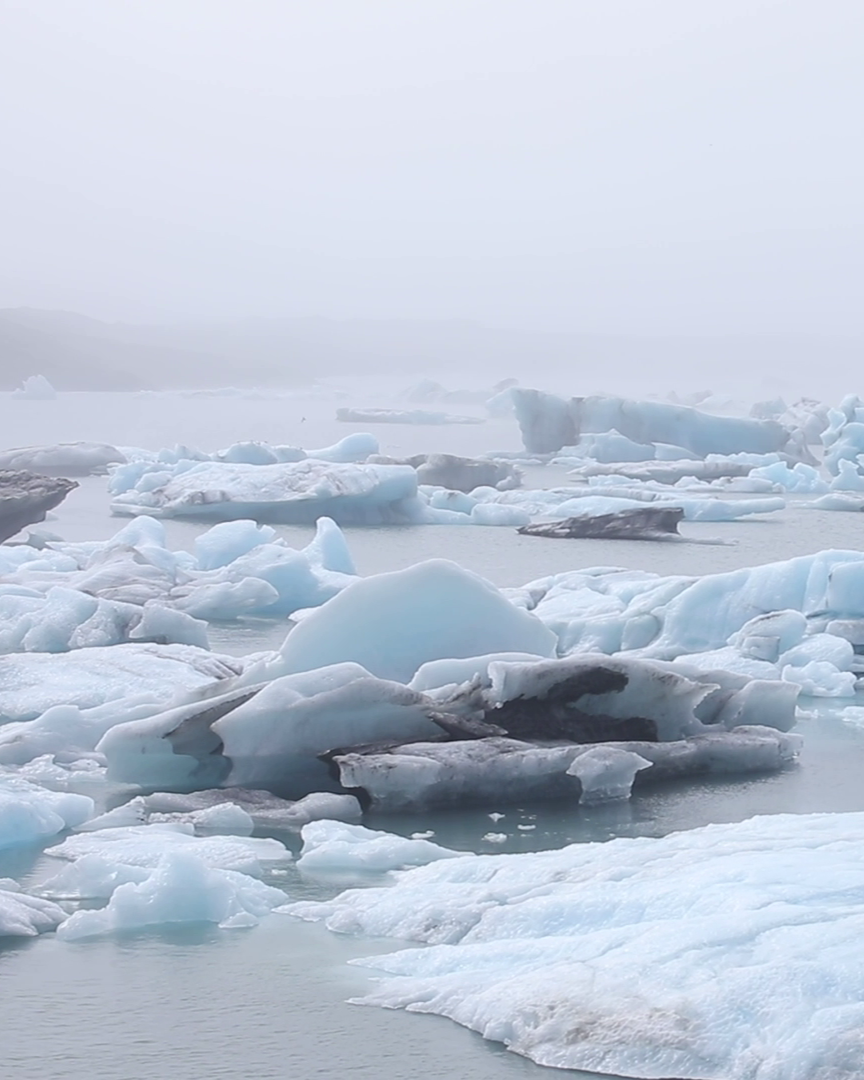


Laura Skehan: A Drowning Melted Persistent Memory
Museum
In this video essay, Skehan weaves together close-ups of mosses and microscopic structures with expansive shots of green deciduous forests, glaciers, and reflective water surfaces. Interspersed with these natural scenes are images of abandoned buildings slowly being reclaimed by plants, creating a dialogue between human absence and ecological persistence.
The repeated laying of tarot cards punctuates the imagery, introducing an element of ritual and contemplation. Through this layered collage of thriving nature, melting ice, and decayed human architecture, the work generates a subtle tension between human impact and nature’s reclamation, between fragility and endurance, inviting reflection on memory and transformation.


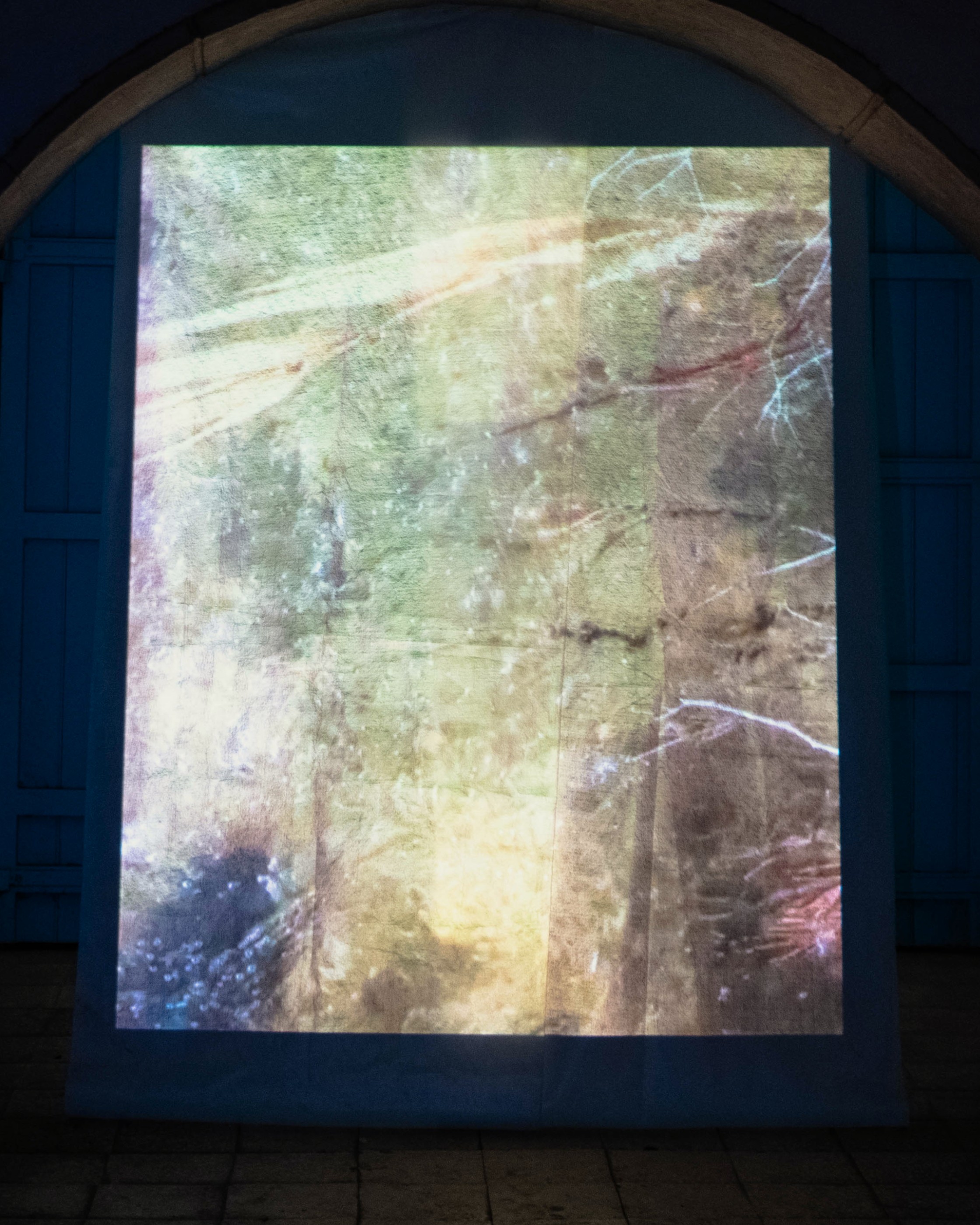
Nicolàs Dardano: Universe Containers
Souk Erbaa
“Universe Containers” unfolded as a sensory immersion, inviting viewers to perceive the fluid boundaries between natural phenomena and digital spin-offs. It is surmised as a meditation on the interconnection between natural processes and digital interpretation, offering a contemplative experience that merges scientific observation, poetic reflection, and technological creativity.
The footage followed the pouring of water and sediment into natural beds, revealing the dynamic interplay of currents, wind, and light that shape colors, textures, and forms. The flow of water and sand interacts with its habitat, such as topography, soils, vegetation, and animals, generating movement patterns such as streams, spirals, and meanders that influence water velocity and texture. It embodies the meeting point of sky and earth, where natural forces create interference and momentum among light, climate, and matter, resulting in constantly shifting colors, patterns, and textures.
Sound elements by Roisner traced the process of perception, from recordings of dripping, washing, flowing, and running water to evolving electronic textures. Embedded text sections further personalize the contemplation of nature’s complex ecosystems.


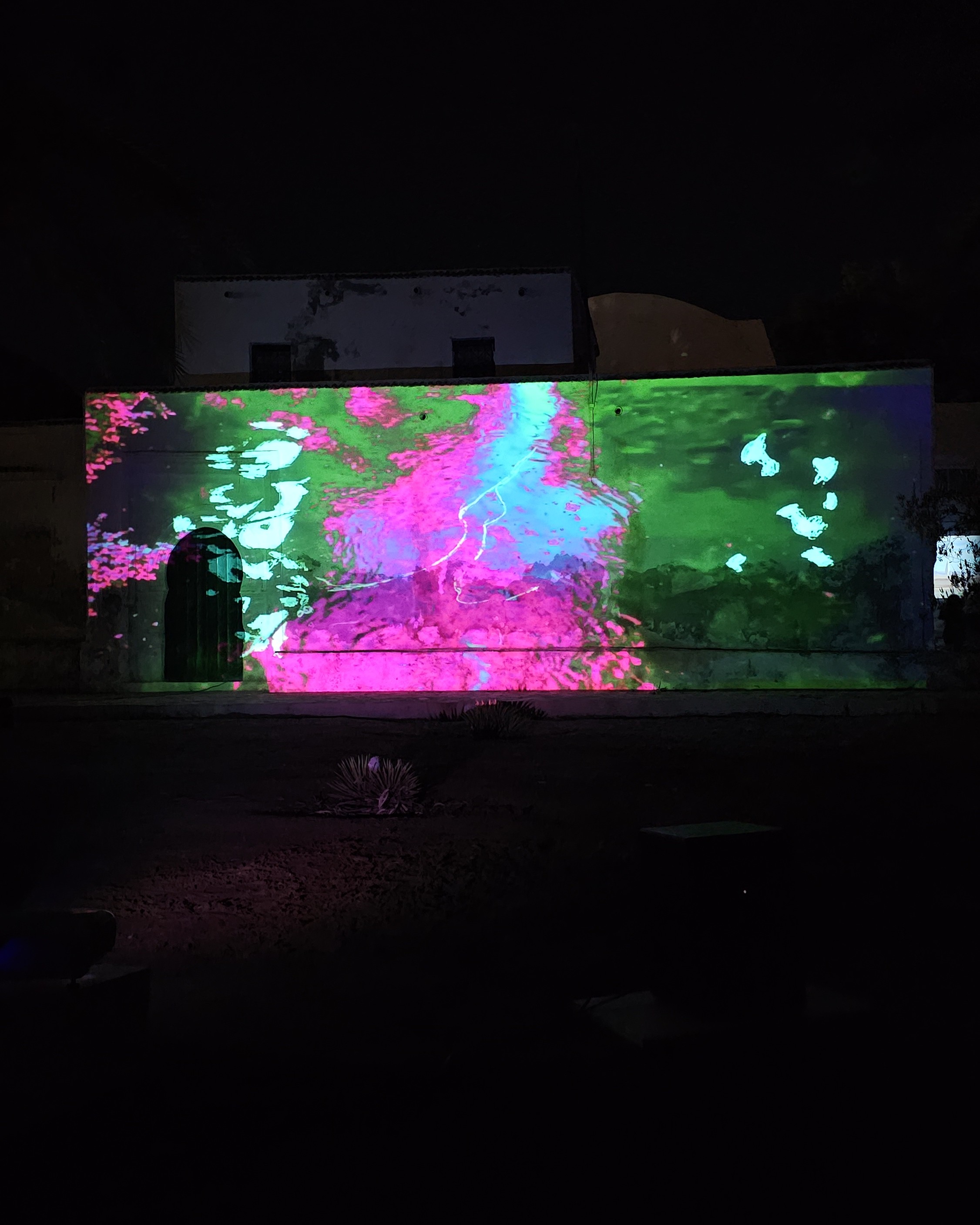


Anja Kreysing: Angel
Museum
Anja Kreysing’s intervention “Angel” transformed the mausoleum of Sidi El Zitouni into a living canvas through a site-specific video essay. For the facade of the 18th-century oratory on the museum’s grounds, Kreysing developed a video installation accompanied by live audio interventions, featuring accordion and electronic sounds. The work offered viewers an immersive, multisensory experience, reflecting on the interplay of memory, place, and natural rhythms, and demonstrating how expanded cinema can reframe heritage sites as spaces for reflection, resonance, and contemporary artistic exploration.
The video essay incorporated experimental manipulations of footage from the small river “Angel” in Münsterland, capturing its fluidity, reflections of light, color shifts, and distortions caused by water currents. These digital interventions were combined with hand-drawn, analog image techniques, creating a layered visual experience.
The live soundtrack fused manipulated field recordings of the river with Kreysing’s accordion and synthesized sounds, merging with local, real-time improvisations to craft a soundscape that resonates with the site while amplifying the river’s natural and temporal rhythms.
EXPANDING TO THE GUELLALA MUSEUM
SEE DJERBA’s 2025 chapter in Guellala unfolded as an experimental visit to the island’s Heritage Museum. For one night, artists and curators temporarily took over spaces dedicated to preserving the past and re‑inscribed them with the language of contemporary media art. The experimental visit did not aim to modernise tradition, but to expose the frictions between embodied local knowledge and global media imaginaries. Guellala’s clay, crafts, and oral histories met cameras, sensors, and projections; the result was a provisional, fragile assemblage rather than a fixed display.
This temporary occupation suggested a different role for heritage museums in the Mediterranean: not only as guardians of a finished past, but as hosts for unfinished conversations. In Guellala, SEE DJERBA turned the museum into a site where contemporary media art could listen to, amplify, and sometimes contradict the narratives that usually defined the island’s cultural identity.
SEE DJERBA – A UNIQUE ECOSYSTEM
SEE DJERBA creates opportunities for artists, curators, mediators, cultural leaders, designers, activists, and thinkers to co-act. It anchors itself in collective living, artistic research, curatorial practice, critical thinking, and public discourse. By bridging diverse communities and fostering dialogue between experts and the general public, it aims to build not only a platform for cultural exchange but a movement for sustainability, inclusion, and social innovation. Open calls, exhibitions, conferences, and workshops ensure the ecosystem stays porous and participatory — always ready to shape the present and imagine a better tomorrow.
SEE DJERBA developed as an interconnected network of people, projects, and platforms. It became a creative infrastructure formed over a decade, driven by contemporary art amid the digital shift, shaped by environmental and societal challenges, and continually refined through open collaboration and critical public engagement.
With each cycle, new energies and perspectives are woven into the ecosystem’s fabric, allowing the festival to adapt and thrive in the face of changing realities. Every edition grows through the participation of new and seasoned community members, each contributing to and learning from local initiatives, partner institutions, and peer festivals.
Every edition is themed to highlight urgent ecological and cultural questions, drawing artists and activists, citizens and practitioners from universities, museums, galleries, and NGOs from around the world to Djerba for dialogue and exchange. The project’s community designs exhibitions, stages, and forums to showcase new artwork and incubate ideas across disciplines. It champions collective effort and care, with a clear commitment to critical discussion, ecological awareness, and public participation. Online and on-site workshops, residencies, and networking events provide ongoing spaces for new collaborations.
To date, SEE DJERBA offers a framework for established artists and serves as a launchpad for emerging artists and pioneers. Inclusive curation foregrounds new voices at the intersection of art, media, heritage, and civil society. By honoring local context and inviting international perspectives, the festival sustains an environment in which innovation and tradition inform one another.
SEE DJERBA operates within a challenging funding landscape that underscores the precarity often faced by contemporary art initiatives, especially in regions outside major metropolitan centers. Despite its growing international recognition and the critical cultural role it plays in southern Tunisia, the festival and its broader ecosystem rely heavily on a patchwork of limited public subsidies, grants, and project-based partnerships. This irregular and competitive funding environment demands constant innovation and adaptive strategies to sustain program continuity, artist support, and community engagement.
Nevertheless, SEE DJERBA’s commitment to maintaining free public access and promoting inclusivity sometimes constrains available financial resources, compelling organizers to seek further collaborations with cultural institutions, NGOs, and industry partners to secure the festival’s future and expand its impact.
In southern Tunisia, contemporary art activities remain relatively rare compared to the bustling scene in the capital, Tunis. While Tunis has witnessed a surge in new art spaces, galleries, and festivals over the past decade, transforming itself into a hub for both established and emerging artists, the south remains marked by limited infrastructure and fewer opportunities for artistic exchange and public engagement.
This disparity is reflected in the distribution of galleries and cultural platforms, which are primarily centered in and around Tunis, attracting national and international attention and resources. In this regard, SEE DJERBA plays a vital role in challenging centralization, offering southern Tunisia unique access to contemporary art dialogue, nurturing local talent, and fostering cultural activity in regions that the mainstream art world has historically overlooked.
LINKS
SEE DJERBA Media Art Project
ZAKHAM Momentum for Contemporary Culture
@seedjerba
