Bettina Pelz: Into the Dark
Currently on display at the CENTER FOR INTERNATIONAL LIGHT ART in Unna: Jeongmoon Choi contributing to exhibition project LIGHT — LAND — SCAPES jointly with Andreas Schmid, Yoana Tuzharova, and Atelier Rosalie / Thomas Jürgens — until 4 JAN 2026. On the occasion of the exhibition, we talked about her artistic practice.
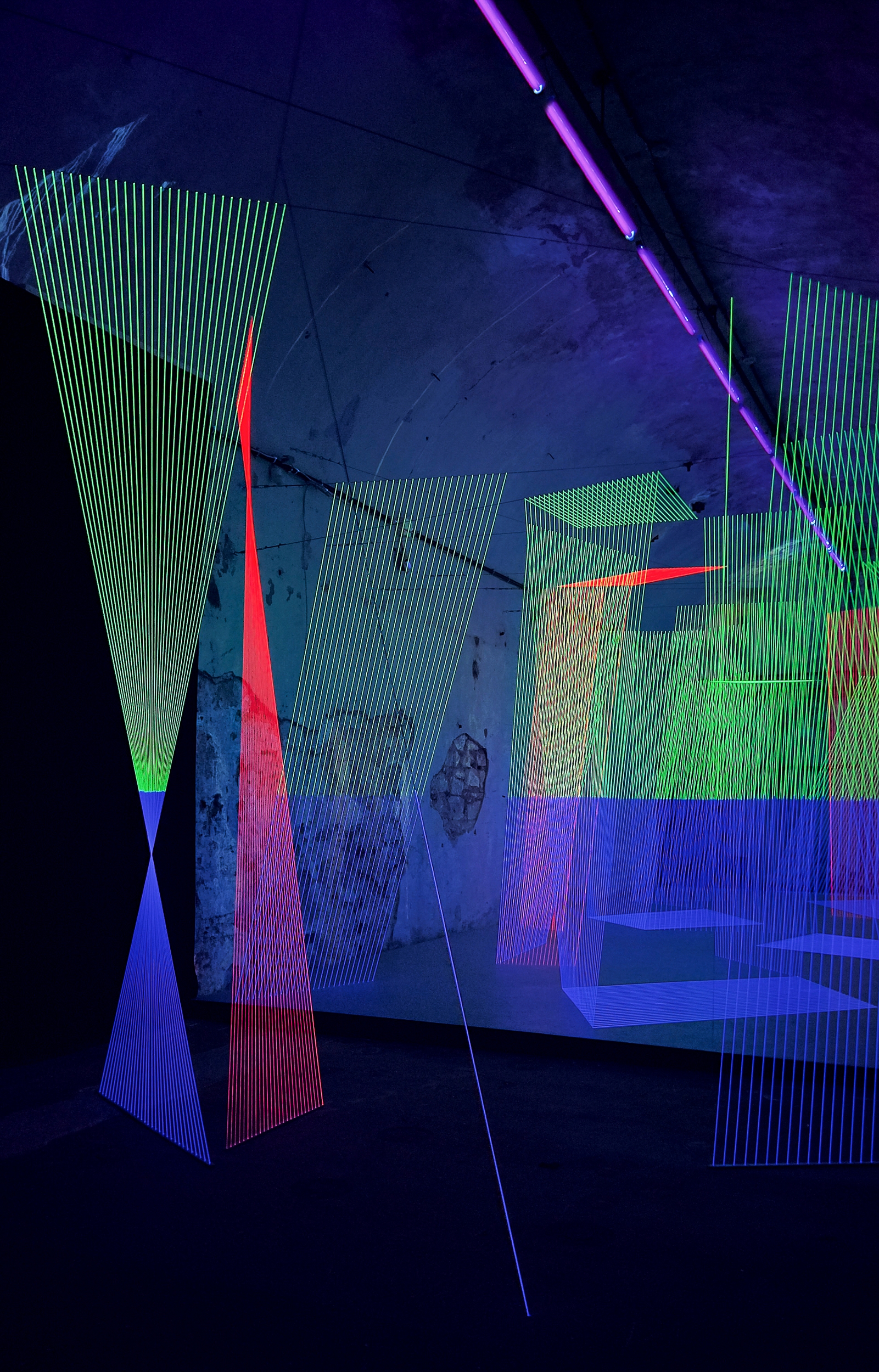

Jeongmoon Choi’s artworks are drawings in space. Her pictorial material is elastic thread with a fluorescent coating, glowing in the dark when exposed to UV light. She develops geometric compositions conditioned by the space they inhabit. The origins and ends of her thread formations disappear into the darkness, her compositions seem to float in space.

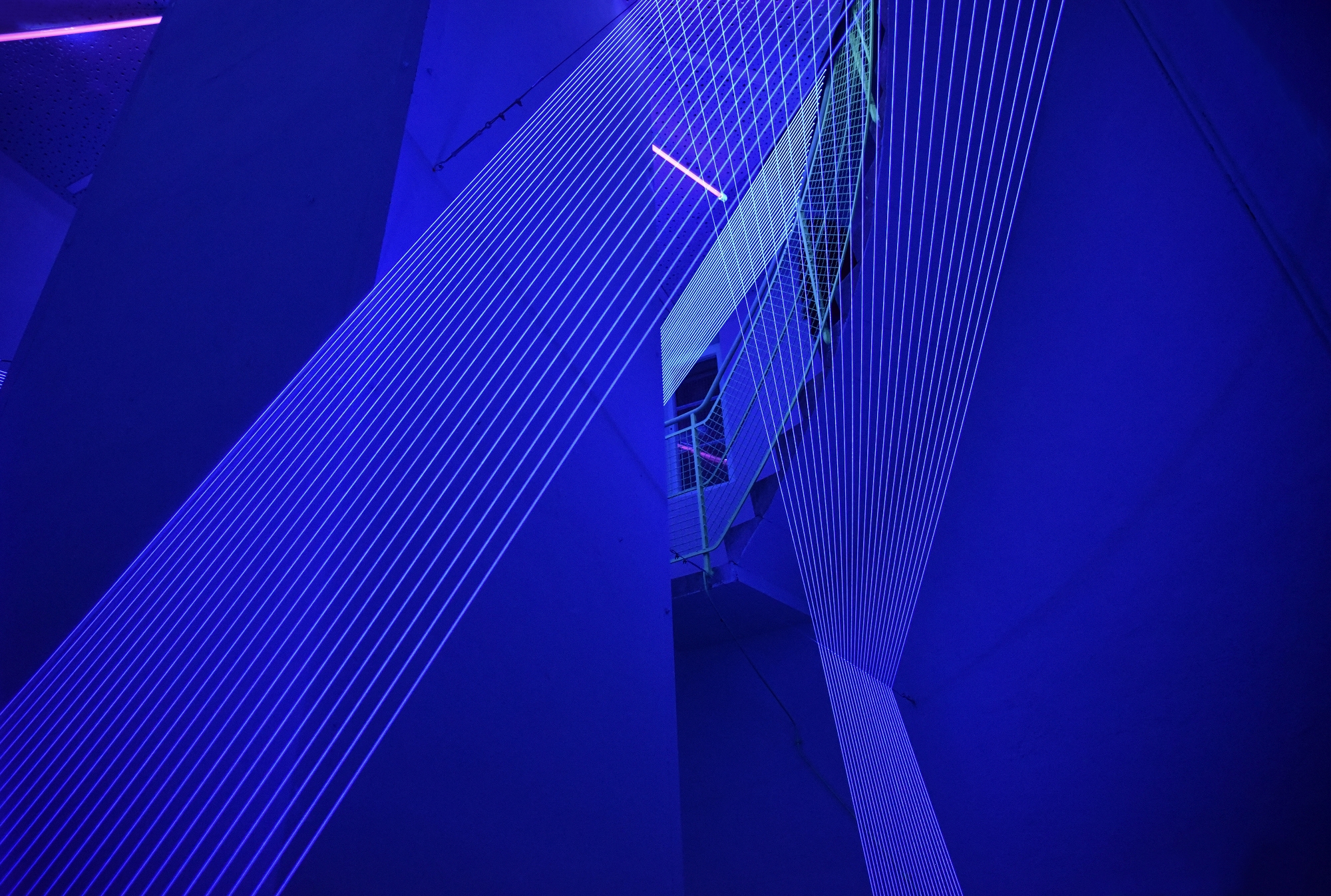
In 2016, I saw her intervention at the AUFSTIEGE Festival in Leonberg. At first sight, her compositions reminded me of Gianni Colombo’s “Spazio Elastico”. From the late 1960s, Colombo developed a series of “elastic spaces”, kinetic systems made of elastic, phosphorescent cords illuminated by UV light. The cords formed a cubic grid network whose rectangular shapes were regularly deformed by motors. Jeongmoon works with a comparable material but unlike Gianni Colombo’s work, her compositions are static and glow in different colors. Their visual dynamics are created by the finely orchestrated composition of light and dark, line and surface, contrast and color.
For more than 20 years, Jeongmoon lives and works in Berlin. She has been participated in light and media art festivals such as EVI LICHTUNGEN in Hildesheim (de), and RE.LIGHT in Regensburg (de), KLANGLICHT in Graz (at) or LUNA in Leeuwarden (nl). She has been exhibiting at the Schwerin State Museum (de), or the Museum of Contemporary Art of Monterrey (mx).
BP// You are currently in Seoul, what are you working on?
JC// I’m currently in Korea a lot because I’d like to get back in touch with the Korean art scene. I’ve been living in Germany since the mid-90s and have unfortunately lost touch with the Korean art scene. I am also looking for a second studio in Korea.
BP// What do you need for a good working atmosphere?
YC// I like to work alone in the studio, and during this time it is very important that there is a concentrated atmosphere. I also often work intensively with assistants. Teamwork creates good moods. For everyday life, I often think: don’t put off until tomorrow what you can do today.
BP// One of your works is currently on display at the CENTER FOR INTERNATIONAL LIGHT ART in Unna. Can you briefly describe your installation for us?
JC// In the “Floating Horizon” installation, I used two colors on one line for the first time. To create the horizontal line, I tied the lines with two color threads that are arranged slightly below human eye level. This time I wanted to give another possibility to the visitors to drive their movements up and down as well, i.e. vertical movements to experience a horizontal line of the landscape.
Over 3000 meters of thread are used here, and it took more than 3500 knots to give the threads tension and hold two different thread colors together. This creates the desired visual tension between the fragility of the threads and the massiveness of the architecture.
BP// For your spatial interventions, you usually have the walls painted black so that they are hidden from view. How did you solve this in Unna?
JC// There are two types of thread and light installations that I create. In the first case, the installation is realized in a black box (painted black). Here the lines look much more like a beam of light (laser). And the black environment leads to visitors not feeling the boundaries of the space and experiencing a confusing perception of the space.
In Unna, the space has remained unrenovated and has a tunnel-like shape, which I found architecturally very interesting. I didn’t see this as an obstacle to my work, but as a challenge to realize a new, site-specific work. There was only one thing that was absolutely necessary for the installation, a floor surface made of wooden boards to level out the uneven concrete floor and to fix the thread to the floor. The museum took care of this and laid a new wooden floor.
BP// To what extent do you see your work as site-specific? How did you go about developing the installation in Unna?
YC// I start each installation with the space and develop a specific concept for the space. The realization of the work is created intensively on site. I visited the museum in Unna twice before I started with the concept. The space itself was interesting to me and I was very interested in showing the character of the space with fragile threads. The word “horizon” came to mind and then I started to work out a plan. The space is underground and made of masonry. I wanted to create a relationship between the solid architectural form and the fragile threads.
BP// You are a craftswoman: you draw every line, every thread yourself. What role does that play in your installations? Do you design your installations as hand drawings or as computer animations?
YC// I draw in space, and when I used thread as a drawing material, I didn’t want to replace the haptic movements of my hands with threads with technology. That’s how the idea of “between” started: between “analog and digital” and “position and perception”.
Every installation starts with the space. Sometimes I have to be very precise, measure, calculate, plan and work out an exact concept. But sometimes I let the space inspire me. Depending on the spatial situation, I develop my concept. I often immediately have an image in my head when I visit the space or see photos of the room. When working in public spaces, there are unforeseeable incidents and obstacles that force me to improvise and to which I have to adapt my concept. Ideally, I have the opportunity to view the space beforehand. I then use the floor plan and photos of the room to plan what I have done myself on site. I build a model of the room or create a room plan with a 3D program. As the installation is mainly realized on site, I need a precise plan.
BP// How do you choose the thread material for your installation? Is it stiff like wire, soft like sewing thread or elastic like a rubber band?
When I started with the thread, I used wool crochet thread. Back then, I still had to battle with the weather. When the weather was damp, the threads lost their tension. Then I did a lot of research and found a material for my installation. The threads I have been using since 2015 are somewhat elastic. The threads are often used in our clothing. Only the thickness of the thread is adjusted for my installation and the fluorescent color is also dyed. I have the threads made in a factory in Korea.

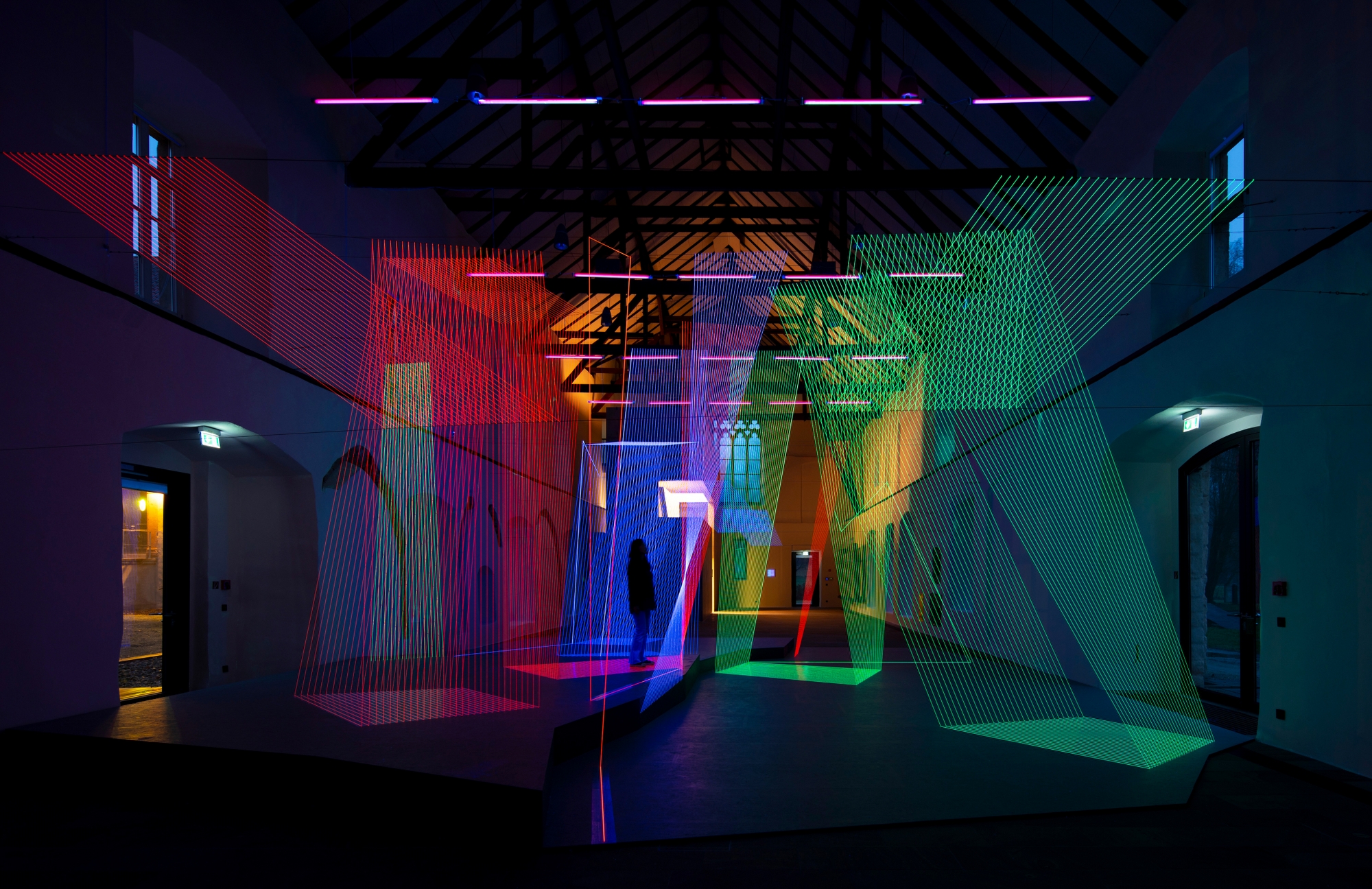
BP// How are your colors created?
YC// I use the fluorescent colors. There are many possibilities for the colors. But they don’t necessarily differ much under black light. I mainly use three colors: White, yellow and pink. Under black light, the colors blue, neon yellow and red/magenta appear.

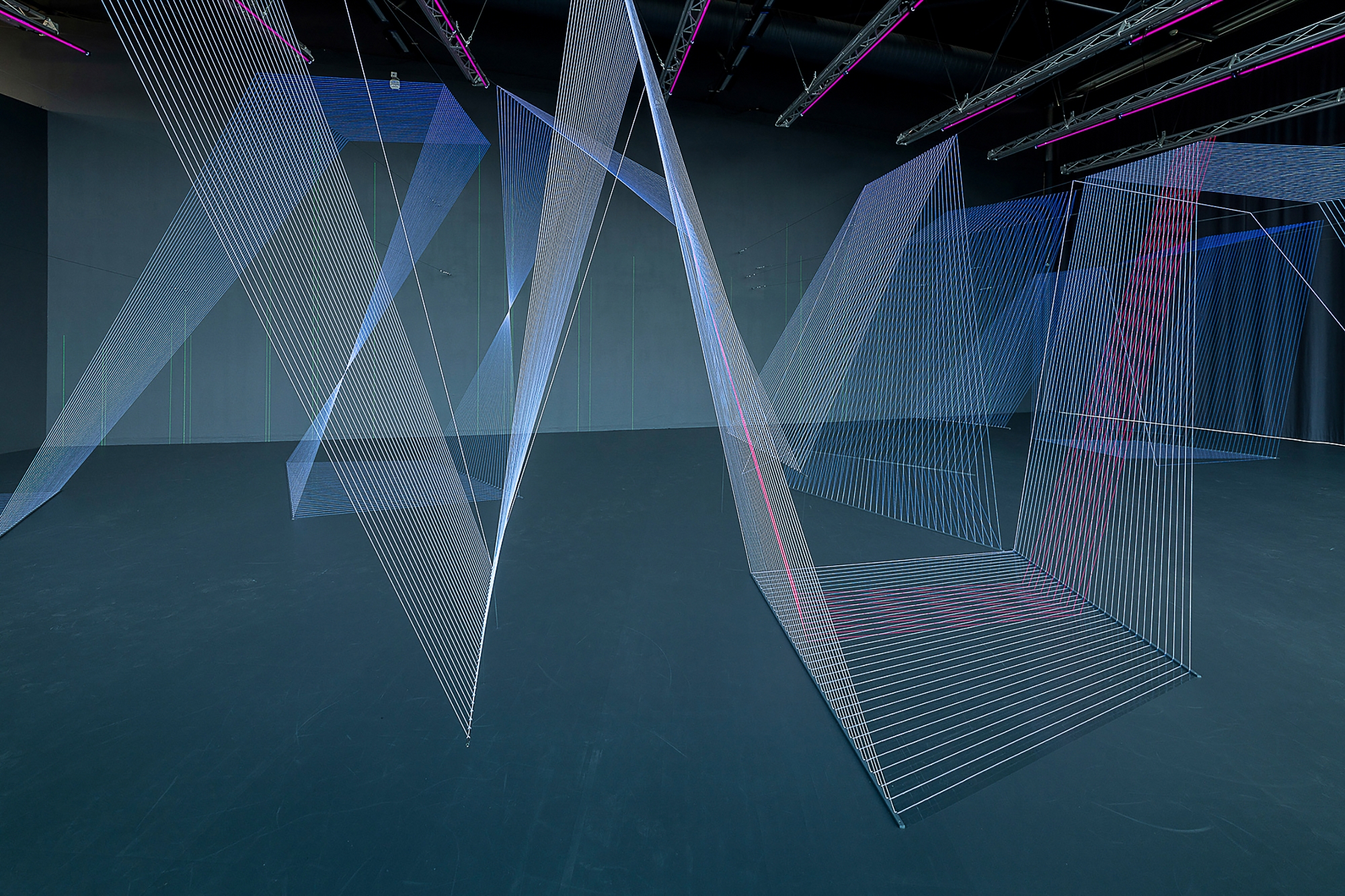
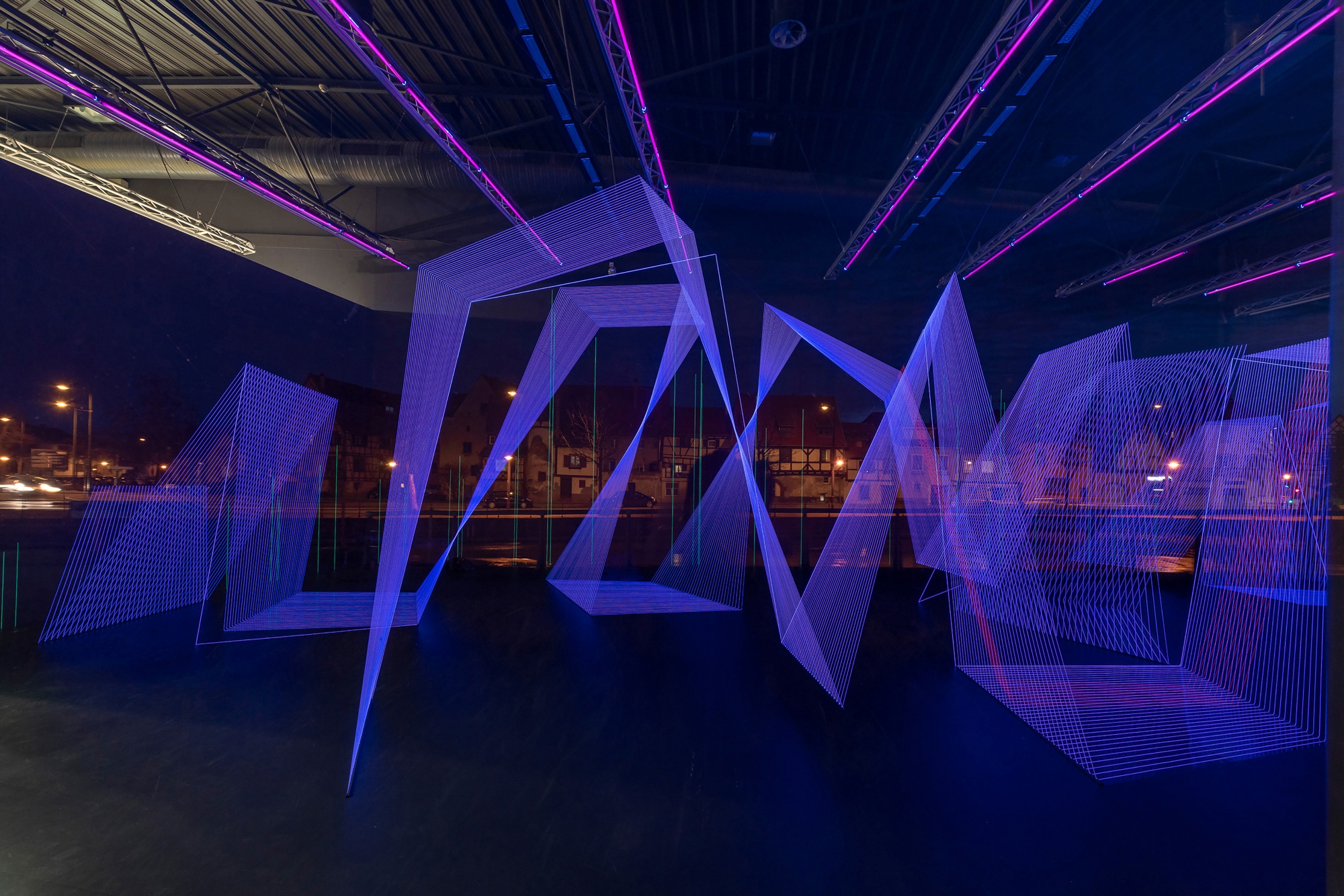
BP// Can the lines also be seen in daylight or are they dependent on UV light?
YC// The thread lines are also somewhat visible in daylight. The color intensity will increase under UV light. There is a good example of me working with daylight and UV light at the same time. In my solo exhibition at the FRAC Alsace in France, I took “nature” as a concept and did not darken the three-sided glass façade, but showed the color changes of the installation over time. In daylight and at dusk and at evening with UV light only. Visitors sometimes came by several times or at dusk so that they could see the gradual changes in the installation.
BP// When did you start working with UV light and why did you choose it?
YC// I have been working with UV light since 2006. When I started making spatial drawings with threads, it was important for me to imagine the space as paper or canvas. In daylight, my drawings have to compete with the surrounding space for the viewer’s attention and in some rooms they don’t come into their own at all. Then I had an idea: I could darken the room, but this would also make my thread drawings invisible. The solution was black light, with which I can illuminate selectively: The lines stand out, the surrounding space recedes. The UV light makes it possible to empty the space a little in order to emphasize the drawing and make visible things invisible and invisible things visible. The UV light causes the space as a three-dimensional work surface surrounding the installation to dissolve its original characteristics in order to create a new space that is inseparable from the installation.
BP// You develop expansive installations, but also small-format reliefs and objects. What role do size and format play for you?
YC// When I wanted to change my workspace from 2D to 3D, I realized that I needed a room as a 3D form. The work should focus on movement and perspective. At the moment, I am developing the opposite approach by creating the 3D work in 2D form. The movements and perspectives are also important in my wall objects or sculptures made of threads. For the Fade Light installation, I find small rooms much more difficult than large rooms. Ideally, the room should be about 70 square meters. This allows me to develop different movements and perspectives. The small-format works are important for me to show the works in the gallery and at exhibitions.
BP// You studied painting, are you still a painter?
YC// I’ve always wanted to paint but haven’t done so yet. In Korea, my painting showed a closeness to German Expressionism. As I moved away from Expressionism in my painting, I became interested in Concrete Art, Minimal Art and Op Art. Max Bill, the leading theorist of concrete art, describes a relationship between art and mathematics that is relevant to many of my works. Sometimes I translate the mathematical and scientific structure of seismic recordings into concrete geometric structures in space.
The transfer of Op Art into three-dimensional space was undertaken by Jesus Rafael Soto, among others, in whose works visitors are invited to interact with the installation. For my work, I use scientific data as a basis, translate it into two- and three-dimensional representations and allow visitors to interact with the installation.
I first became acquainted with Fred Sandback’s works, which are a constant source of inspiration for me, when I had already been working with threads for 2-3 years. Our works have many similarities: He is a sculptor who builds minimalist sculptures with thread in space and I am a draughtswoman who uses thread to realize free drawings in space. “The line is a whole, an identity, for a particular place and time.” This statement by Fred Sandback also characterizes my work.
BP// Do you know the Italian Austrian artist, Esther Stocker? Her works are also rooted in geometric principles. She develops systems in black, white, and gray with small, built-in disruptions. How do you see Esther Stocker’s work?
YC// I am friends with Esther Stocker. I really appreciate her work and admire the diverse range of work she has developed.
BP// How do you approach a place or a context?
YC// The spaces in which I realize an installation are always different. Sometimes the spaces are closed and abstract, sometimes they are integrated into nature. Sometimes there are surprising obstacles on site that I have to deal with. Then I have to make adjustments and find a new solution. My work requires a precise approach, a sure instinct and an eye for detail. At the same time, my work is always in dialog with the natural conditions of the surroundings. The precisely planned perfection of the surface of my installation simultaneously creates an organic form. What materials the room will be made of and where I can hang the lamps are the first questions for the realization of the work. But usually 97% of the planned works are realized.

BP// I have seen your works in very different contexts, such as in landscape-related locations. What are the particular challenges of locations that are embedded in nature? How do experiences of nature influence the way you work?
YC// I am interested in “nature”, especially “natural change” and “natural disaster”. I have done a few works on these topics. The experience of the earthquake has influenced my work. I experienced an earthquake in Athens in 2013 when I was there for an exhibition. It was nothing compared to the 2011 Tohoku earthquake in Japan. But I was very scared and could feel the plate movements and tremors. It was a very strange feeling that I couldn’t forget. Then I started researching and came up with the idea of integrating the recording of natural phenomena into my work. I began to combine natural and artificial light sources to show the temporal transformation of my installations. I use the threads as a central element to create a structure with their fragile stability, reminiscent of the balance between strength and fragility.

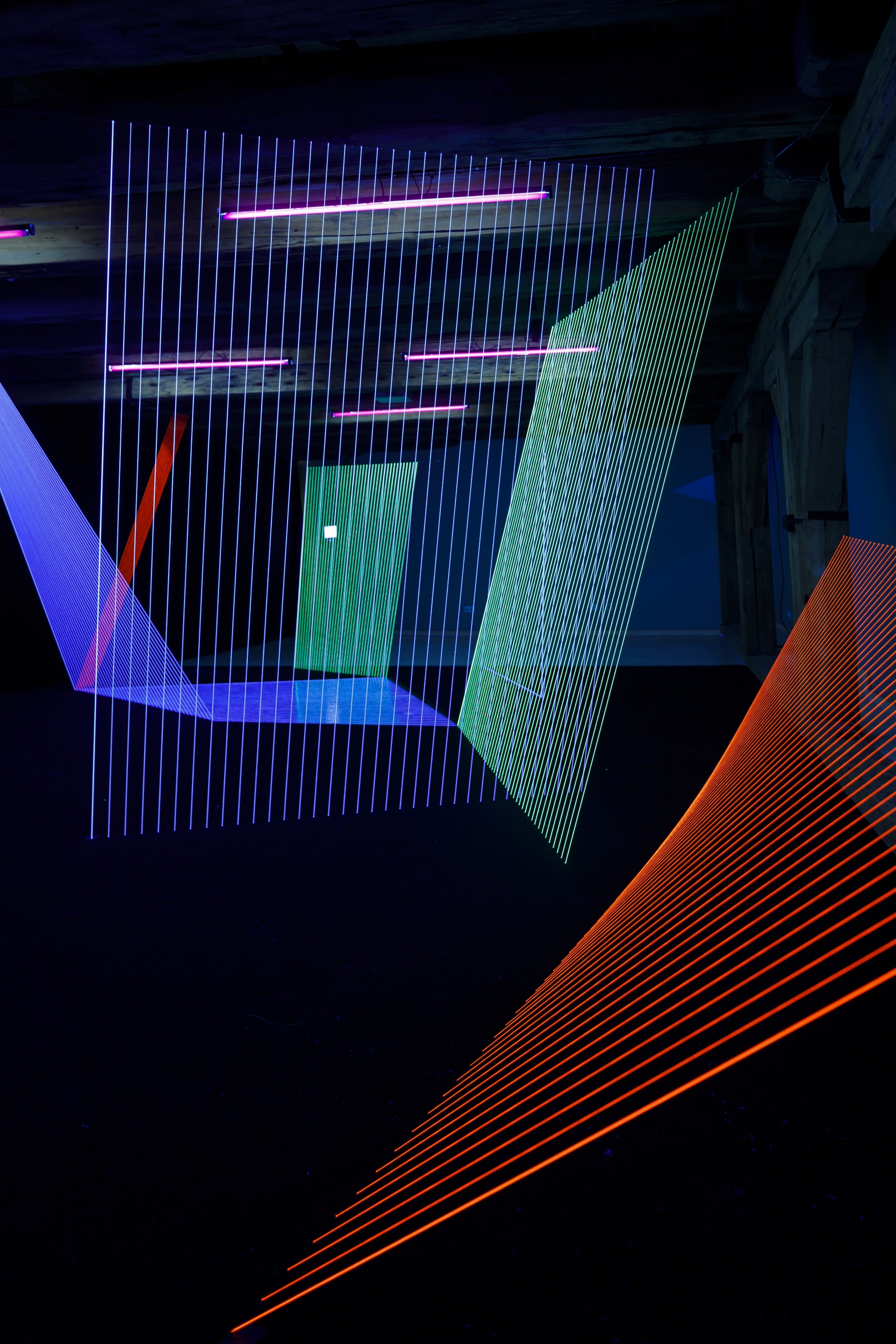
BP// You also enter into a dialog with cultural-historical spaces, such as the “Salzstadel” during the first RE.LIGHT Festival in Regensburg in 2024. How do you open up spaces with history?
YC// Cultural-historical spaces are often more difficult for my work. Because I often have no way of attaching the ropes and threads. But you still find a solution and that’s a challenge for me.
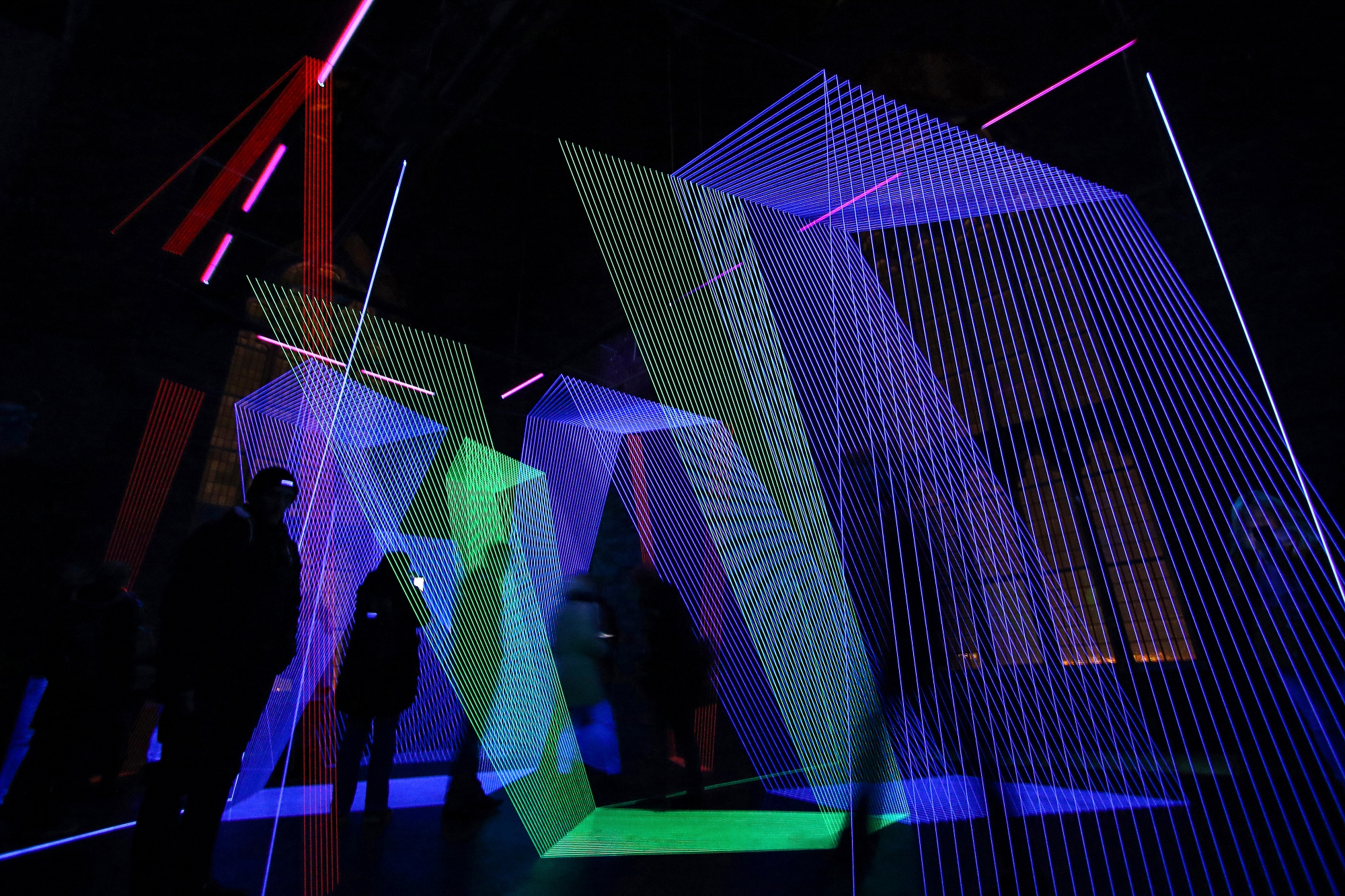

BP// You have also worked with sacred spaces, such as the tower room of St. Andrew’s Church as part of EVI LICHTUNGEN in Hildesheim in 2020 and the former Gravenhorst Monastery in 2023. What is your attitude towards spaces in spiritual and religious contexts?
YC// Here you can see the fundamental difference between art today and in past centuries. Art created for churches once arose from the deep piety of artists, but today churches can be just as attractive to artists as museum spaces, old factories or other places. I am much more inspired by architectural forms.

BP// In 2021, the Kunstmuseum Schwerin showed an installation of yours. Why is it still difficult for artists who work with light and light-based media to be shown in art museums?
YC// I think in many cases the installation and maintenance of light-based artworks requires special technical knowledge and equipment that is not always available in museums. Museums may have to adapt their spaces and exhibition strategies to present light artworks appropriately. For an artist who works with light, the CENTER OF OINTERNATIONAL LIGHT ART is an excellent place to present my work.
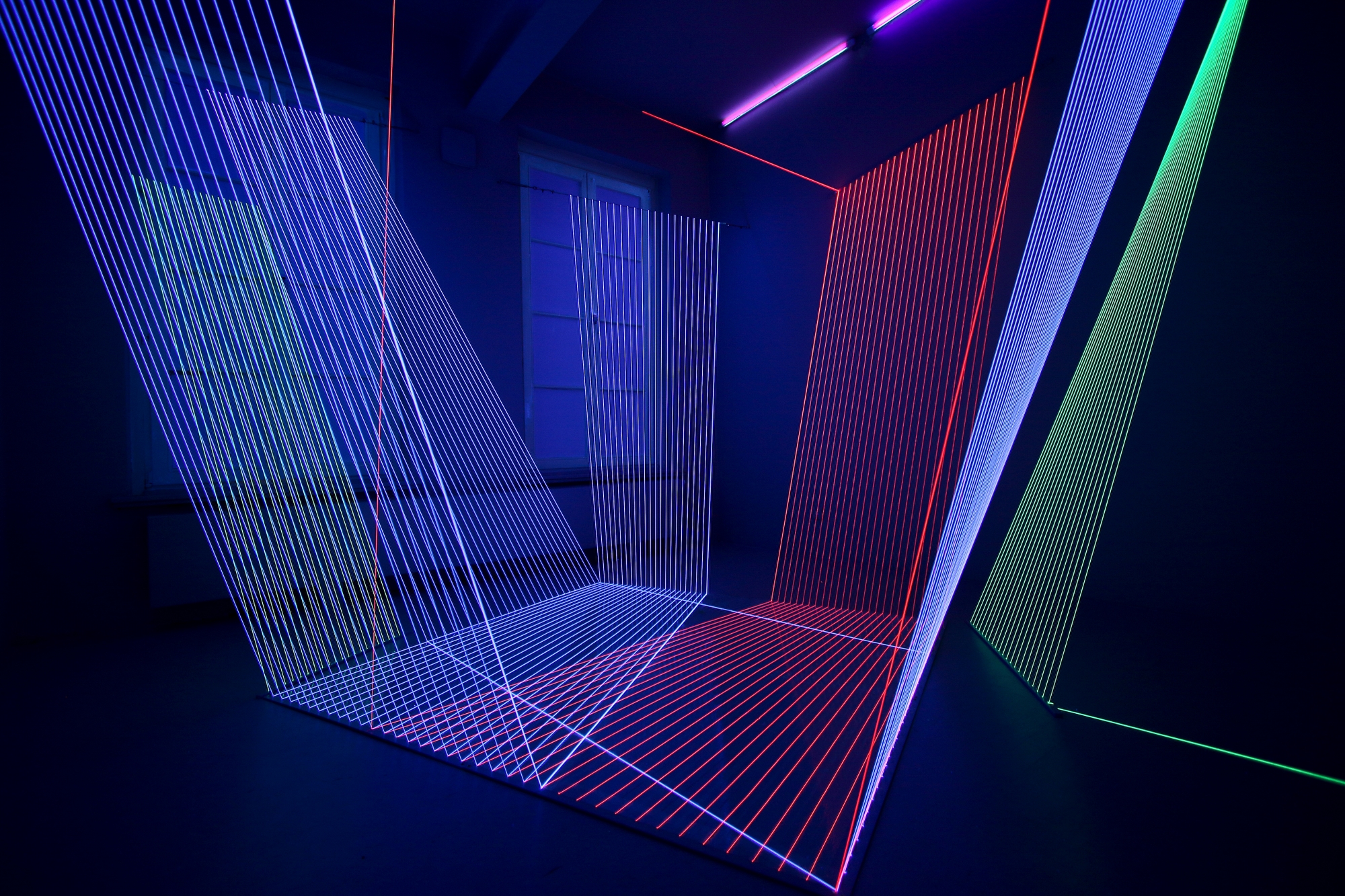
BP// You have also recently started working with GALERIE WATSON in Hamburg. How does working with a gallery differ from working with art initiatives, museums or festivals of light?
YC// GALERIE WATSON focuses on presenting innovative light and media art as well as site-specific installations. A group exhibition with other artists in the gallery working with light also inspires me a lot. The small-scale works are presented at the exhibitions and we try to realize site-specific installations with light in different locations.
YC// I find it important for my existence as an artist to show my work at the fair. Collaborating with various galleries and continuing to exhibit my work in museums and public spaces is important to me. I would particularly like to show my work in an exhibition that is curated in the context of lines, spaces, architecture and light.
BP// Andrea Moeller, director of the LUNA Festival in Leeuwarden, commissioned you to create a site-specific installation in a parking garage in 2022. She is fascinated by your way of working and wrote about you: “Great courage in the design, merciless rigor in the execution, which achieves the lightness of her poetic installations that make the audience forget the original space and achieve a state of mental suspension.” What role do the viewers of your work play? What kind of audience do you want?
YC// In the work, visitors are invited to stroll through the installation, to be part of the installation as discoverers and to interact with it. Visitors are also required to make a certain effort to get involved with the installation, to engage with it so that they can have many physical experiences of their own. My installations can be experienced interactively for many of our senses.
BP// What makes the current exhibition in Unna a “must-see”?
I am very happy to invite the public to the exhibition “LIGHT — LAND — SCAPES”, which I am participating in. The exhibition runs until January 4, 2026 at the Center for International Light Art in Unna. The four installations developed respond to the characteristic architecture of the underground location. Visitors are invited to see the landscape no longer as a reflection of nature, but as a sensual interplay of light, space and experience. Luminous topographies are created in the deep underground tunnels – not images of nature, but accessible experiential spaces between art, architecture and perception. In addition to the temporary exhibition, lovers of light art can also visit the museum’s large collection.
LINKS
Jeongmoon Choi
Center for International Light Art
Esther Stocker
Gianni Colombo
Jesus Rafael Soto
